Categories
The Victorians

The Overlooked Fragrance Culture of the Victorians

First – a quick quiz…true or false?

  • Victorians didn’t use a lot of perfume.
  • Perfume was about vanity, nothing else.
  • Perfume was only for the wealthy.
  • Strong perfume was fashionable.
  • Working-class people didn’t care about how they smelled.

All the above statements are false.

So, let me explain a little more.

We often have an extreme idea of the Victorians as staid, stiff-upper lipped gentlemen or dirty street urchins. While these stereotypes existed – and often make for great storytelling – the Victorians enjoyed the pleasures of life more than we tend to think, perfumes included.

The royal precedent

Full immersion bathing was less frequent than today, but Victorians were very concerned with cleanliness. Daily washing of hands, face and body with cloths was common. Scented waters were widely used to freshen the skin and clothing between washes.

Typical fragrances were delicate florals – violet, rose, jasmine – to name a few. Several high-end perfume houses were established during this era – Floris London and Penhaligon’s, for example.

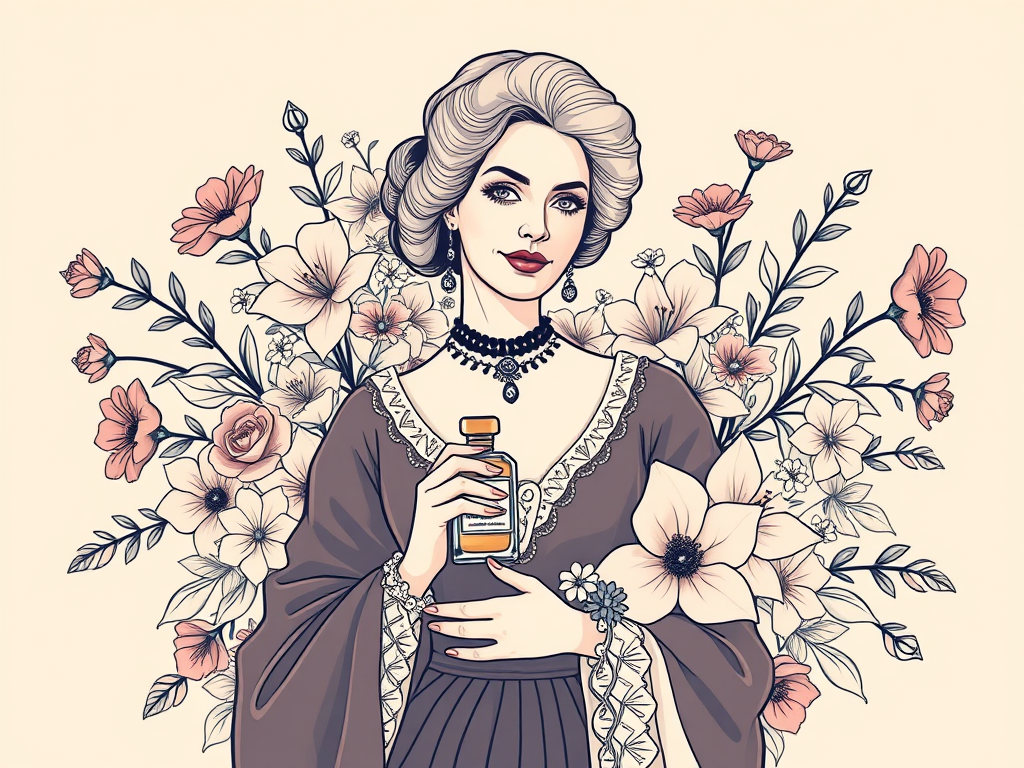
Queen Victoria had a surprisingly important influence on the spread of perfume and personal grooming. Despite the idea we often have of Victorians being prudish and anti-vanity, Victoria enjoyed fragrance and helped normalise perfume use across society, She had a liking for rose, orange blossom, lavender and violet, and a royal warrant could turn a perfume into an overnight success.

Fontaine Limited, Public domain, via Wikimedia Commons

The house of Creed – another distinguished perfume house that still exists today – created a bespoke scent for Victoria called ” Fleurs de Bulgarie” with an emphasis on rose. Sadly, this is no longer available today, but where Queen V went, everyone else followed, even if it was only a cheaper version.
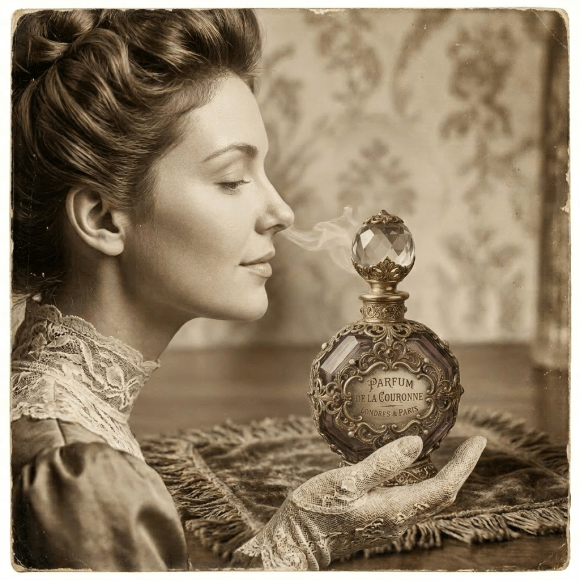
Antique decorative perfume bottle with intricate gold filigree and purple glass
An antique ornate perfume bottle labeled ‘Parfum de la Couronne’

The less well-off

Victoria came to the throne in 1837 at only 18 years old. During her reign:

  • mass manufacturing expanded
  • railways transformed distribution
  • department stores grew
  • branded consumer goods became fashionable

Perfume sales benefited enormously from all these factors. Their influence filtered down to the middle classes and working classes and gave a touch of luxury to the less well-heeled. In many ways, Victorian perfume culture was not so different from today’s “affordable luxury” market. Just as modern shoppers treat themselves to a favourite body spray, scented candle or designer-inspired perfume dupe, Victorian consumers often bought small, inexpensive scented items that allowed them to enjoy a hint of elegance without spending a fortune.

Working-class women regularly used scented handkerchiefs, perfumed soap, hair pomade, and sachets to perfume clothing and drawers. On offer for men were hair tonics, pomades and shaving products – often the barber would apply scent after a shave.

Newspapers and magazines promoted affordable fragrances, scented soaps and beauty preparations. This helped create the idea that fragrance was part of a daily routine, not just an aristocratic indulgence.

Modern advertising still uses many of the same ideas. Perfume today is rarely marketed simply due to the smell – it is sold as confidence, attractiveness, sophistication or self-care. Victorian advertisers were already doing something remarkably similar over 150 years ago.

Perfumes and Miasmas

An interesting Victorian belief was that pleasant smells could actually protect health. Before germ theory became fully accepted, many people believed disease spread through “miasmas” – bad air or foul smells.

As a result, pleasant scents were often viewed as healthy or protective. Lavender, herbs such as thyme or rosemary, and floral waters were believed to purify the air.
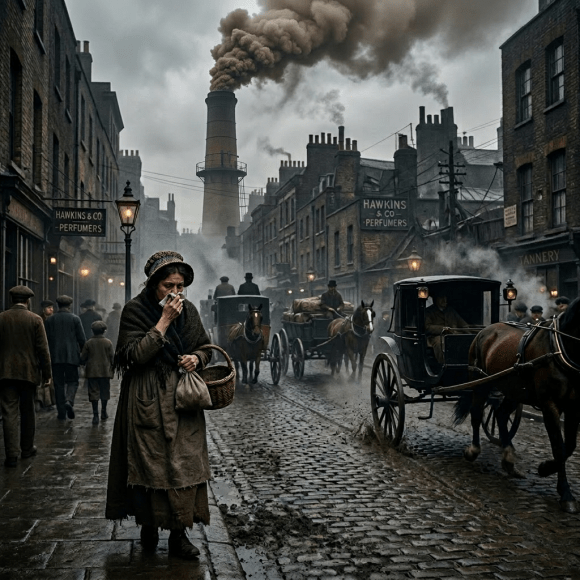
Victorian industrial street with pedestrians, horse carriages, and factory smoke
A somber industrial-era street bustling with horse-drawn carriages and pedestrians amid smoke and fog

Ironically, while we now understand that disease is caused by germs rather than “bad air,” many people still associate certain scents with cleanliness and wellbeing. Lavender sprays for sleep, eucalyptus oils during winter illnesses and “fresh linen” cleaning products all show that fragrance remains psychologically linked to our health and comfort.

Practicality

Victorian cities could smell dreadful. Besides unregulated industries, factories and smoke pollution, there was also overcrowded housing, horse manure in the streets and poor drainage. Perfume and scented products also had a practical purpose in that it masked unpleasant odours. Not so different from our modern-day deoderants and body sprays.

Lavender, rose, violet, bergamot and lemon verbena were popular. Lavender water was especially common because it was relatively inexpensive, strongly associated with freshness and cleanliness and therefor found everywhere in Victorian England.

This meant scent was associated not only with beauty, but also with:

  • health
  • cleanliness
  • safety

But for the working classes, smelling pleasant had even more significance – it conveyed self-respect, cleanliness, morality and social aspiration.

Scent and Respectability

Victorian society placed enormous importance on appearing “respectable.”

For the working classes, smelling pleasant could help convey:

  • cleanliness
  • self-respect
  • morality
  • femininity
  • social aspiration

A factory girl or servant might not own expensive jewellery, but a dab of scent or scented soap could provide a small feeling of refinement and dignity. This was especially important because the Victorian middle and upper classes often unfairly associated bad smells with moral failings or poverty itself.

Even today, many people describe perfume as emotional armour – something that provides confidence before a difficult day, an important meeting or a social occasion. Victorians may not have used that phrase, but they clearly understood the feeling.

At the other end of the scale, wearing too much perfume or wearing a heady, exotic scent was perceived to be unsuitable, or even immoral. Heavy animalic scents popular in parts of 18th-century Europe became less fashionable, partly because Victorian ideals increasingly linked femininity with freshness, delicacy and purity.

The Victorians were also quite obsessed with purity, morality and the symbolic language of flowers – for more info see https://english-stuff.com/2023/09/15/the-language-of-flowers/

In short….
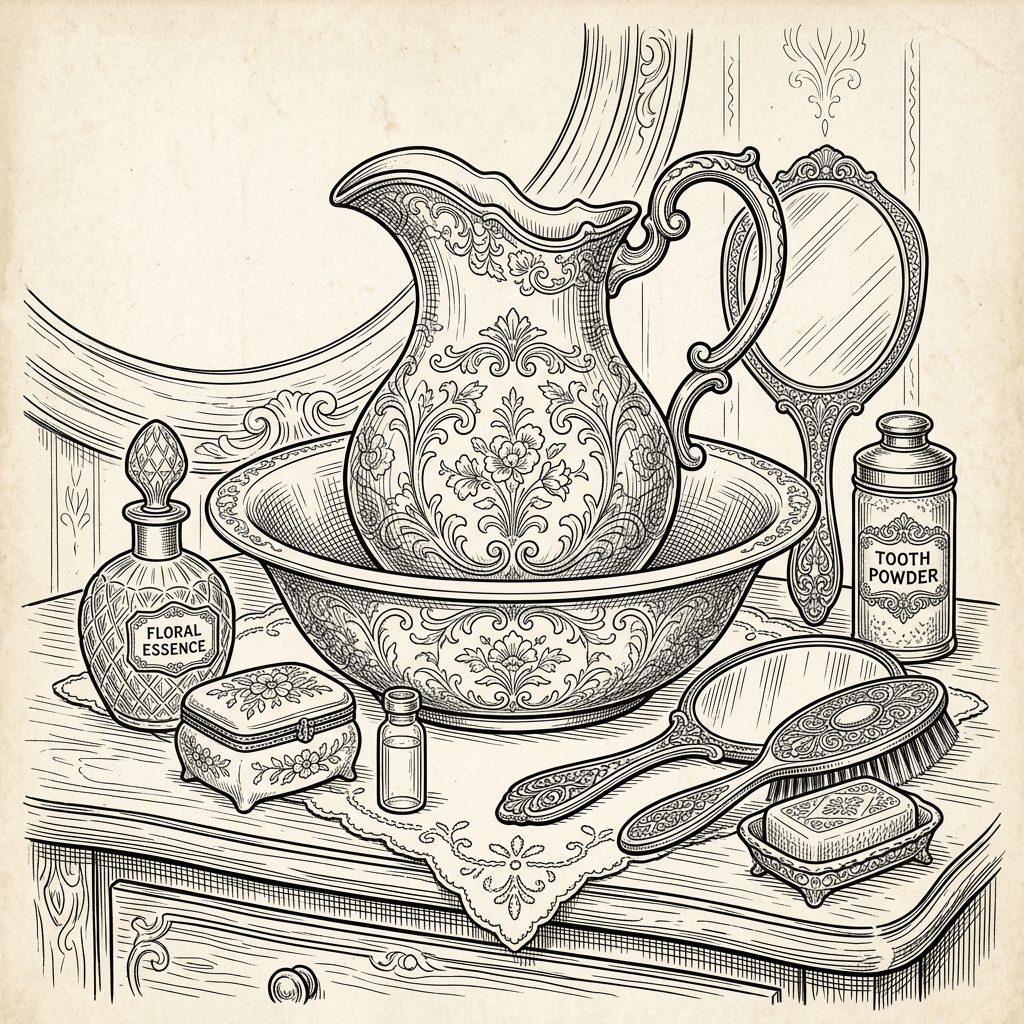
Victorian-era ornate pitcher and basin with toiletry items
An elegant Victorian-style toiletry set arranged on a wooden dresser

So Victorian life was probably far more fragrant than modern stereotypes suggest. While fine perfumes remained symbols of wealth, Victorian fragrance culture reached far beyond the aristocracy.

For working-class men and women, scent offered practicality, dignity, comfort and a small touch of luxury in often difficult lives. In many ways, our relationship with fragrance today – whether it’s a designer perfume, a favourite shampoo or a comforting room scent – is not quite as different from the Victorians’ as we might imagine.

Which scents instantly make you feel comforted, nostalgic or at home?

Categories
English history The Victorians

The History of Christmas Pudding: A Timeless Tradition

Sweet Christmas

A Christmas pudding is a British emblem of Yuletide. Love it or loathe it, no traditional British Christmas meal is complete without one. Similar to Brussel sprouts, (which tend to be more loathed than loved but also still make an appearance) our Christmas dessert, in my humble opinion, is part and parcel of the Christmas festivities.

Our beloved Christmas pudding has history – it’s been around for longer than you might think.

Who made the first Christmas pudding?

Sadly, we do not know the name of the person who invented our pudding. But we do know that its forerunner, a type of pottage, a mixture of beef, suet, dried fruit and spices existed in England in the Middle Ages. Pottage was the name for a soupy kind of stew, generally eaten by peasants, and comprised of ingredients that were readily available to them – mainly vegetables and pulses. If the nobility chose to eat pottage, then more expensive items such as spices and meat would be included.

Many pottages later, around the end of the Tudor era, our pudding gained a more solid form, and a new name, plum pudding, but beef still figured amongst its ingredients. It was also a possibility that there were actually no plums in the pudding, plum being used to refer to various different fruits. At the same time the humble pottage was also still in existence and no doubt the size of your wallet would decide which version you chose.

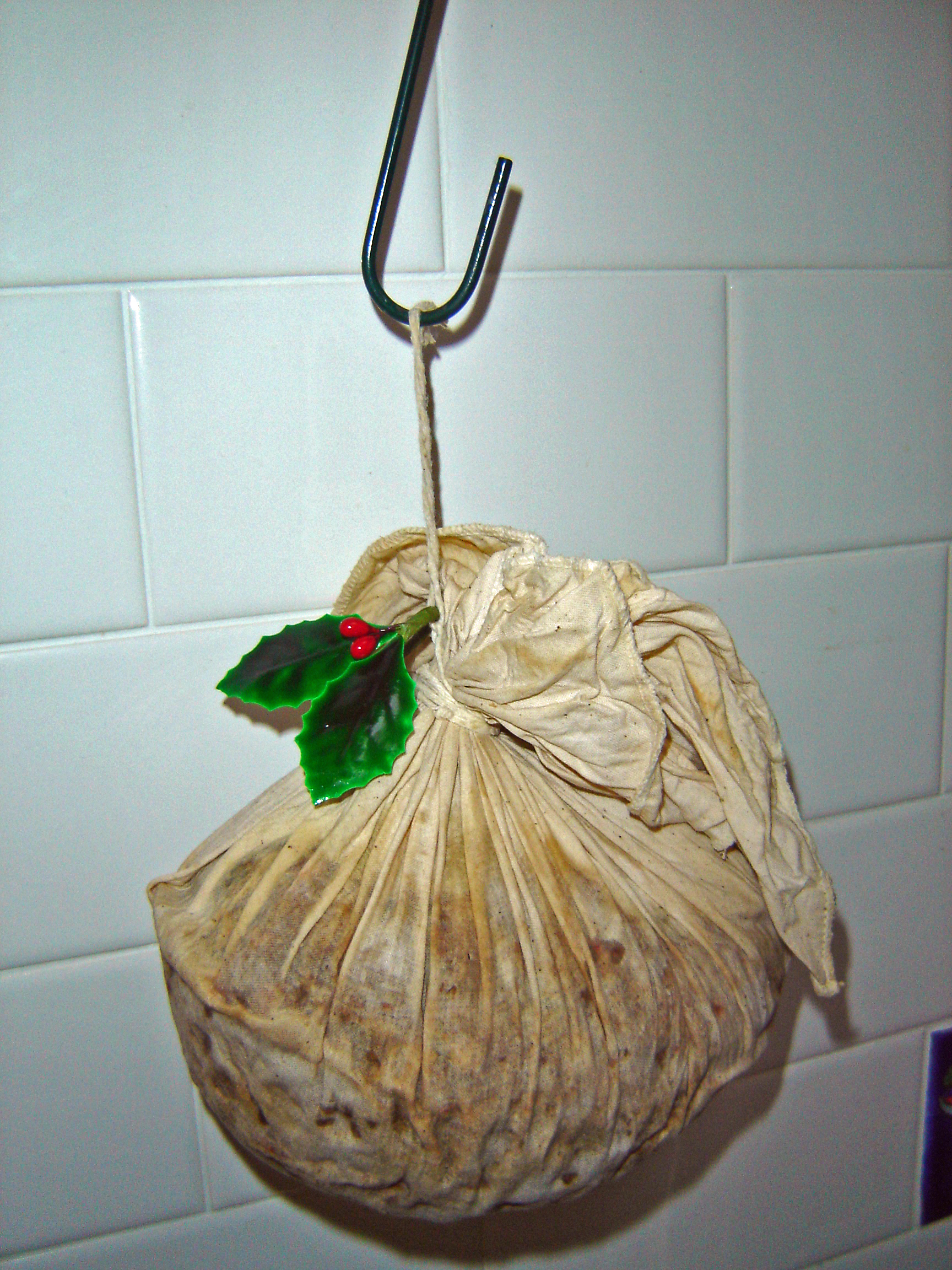
A Christmas pudding hanging on a hook to dry. Photographed by DO’Neil.

In the 18th century, pudding cloths arrived, supplanting the animal intestines that had been used before ( yes, better not to think about it…). The mixture would be left in a muslin cloth for some time, followed by a lengthy cooking process. This is when plum pudding began to acquire the spherical shape that we know so well today. It was generally eaten alongside beef, if you were well-heeled enough to afford it, of course.

The golden age of Christmas pudding

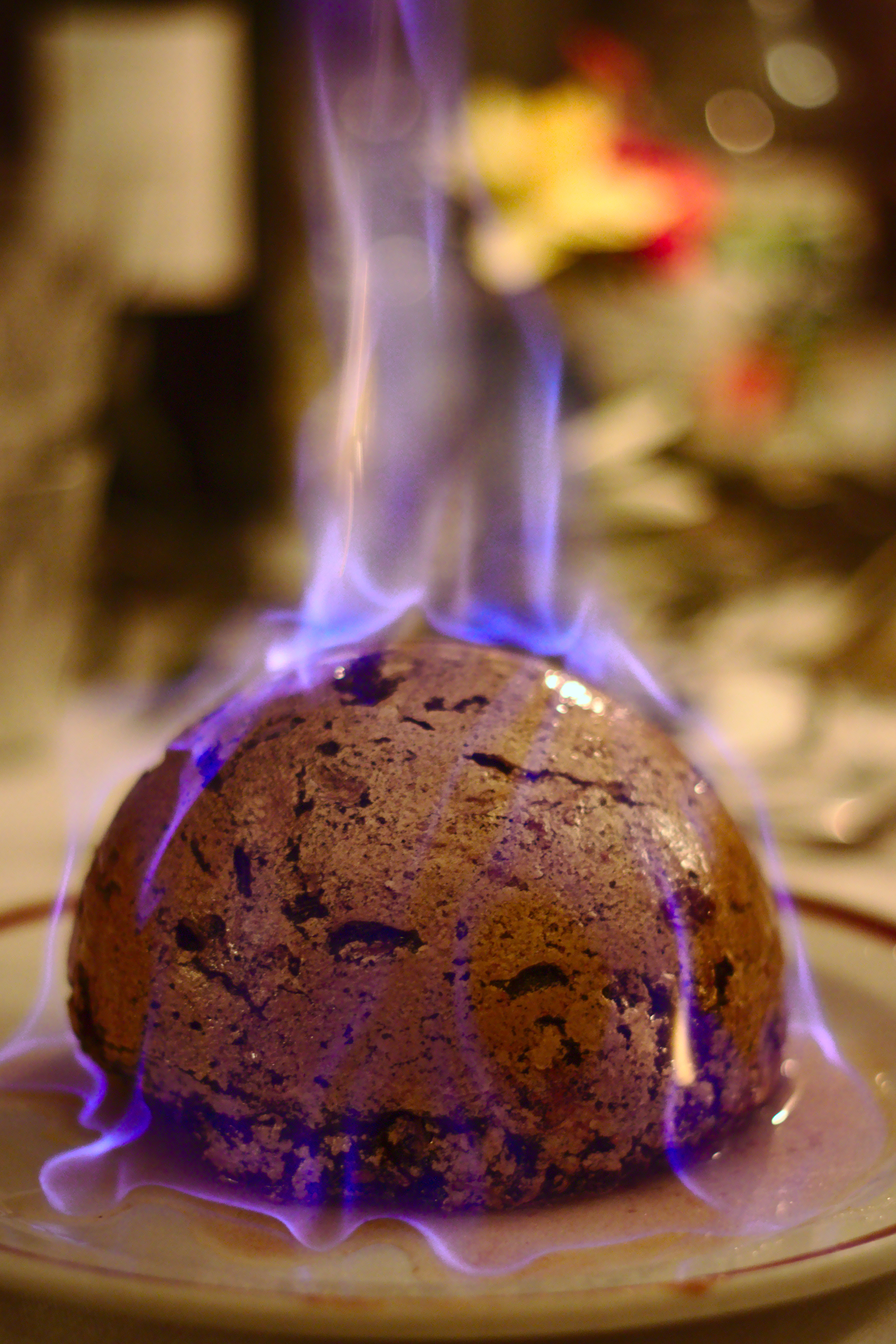
Fast-forwarding to the Victorian era, Queen Victoria and Prince Albert were known to enjoy lavish meals at Christmas, (see: https://wordpress.com/post/english-stuff.com/1197 ) with plum pudding often on the menu. Charles Dickens also promoted the idea of a Christmas pudding as a special delicacy at the end of A Christmas Carol when Mrs. Cratchit presents a sweet, round pudding, blazing in ignited brandy.

A Christmas pudding being flamed. Author Ed.g2s

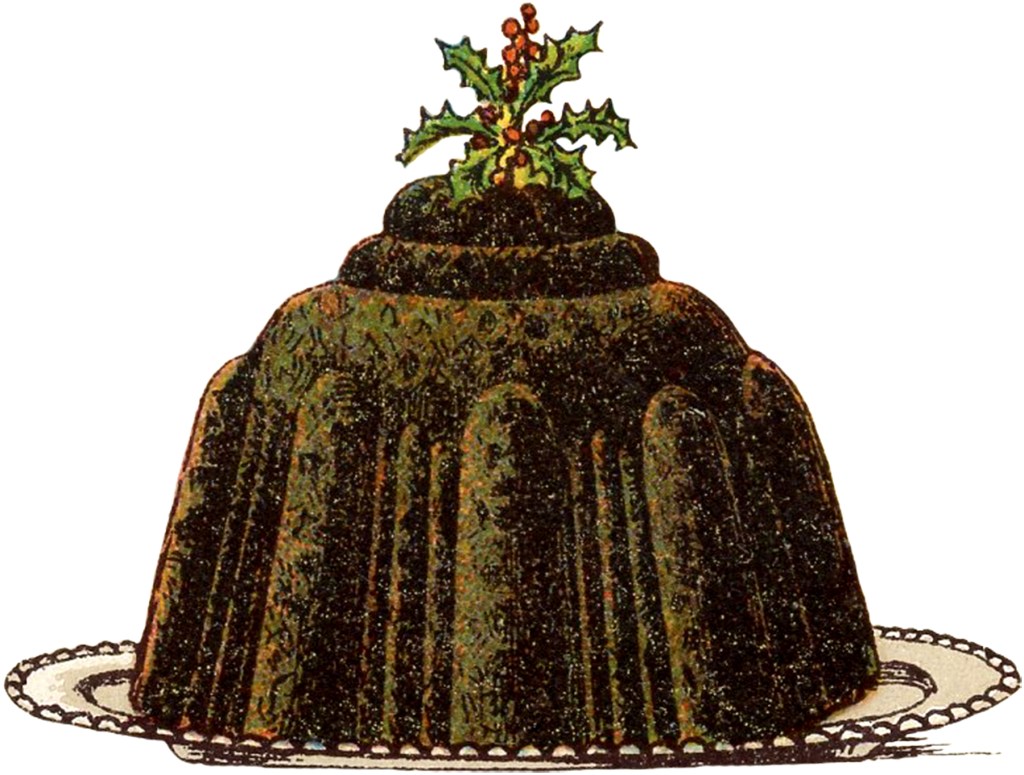
Two years after the publication of A Christmas Carol, our dish appeared as an official “Christmas pudding” in Eliza Acton’s Modern Cookery for Private Families, a bestseller in 1845. This was Christmas pudding as we would recognise it – that is, a round sweet pudding, with no beef, but plenty of fruit and spices. The pudding mixture could be moulded to give it a more ornate shape. It was however, still served alongside the meat course.

Vintage Plum Pudding Image. Author : Graphics Fairy

Demise of the Christmas pudding?

During the twentieth century, this sweet dish became exactly that – the dessert we instantly recognise, served with cream, custard or brandy butter. Supermarkets began to stock a convenient packaged version, which only needs to be heated and served.

But times continue to change. Nowadays many older Brits, (but certainly not all), are still attached to Christmas pudding, maybe because it has been part of our lives for so long. However, the younger generation, it seems, are not particularly supportive of the Christmas pud, probably as it usually follows a very rich and heavy first and second course. The Royal Mint in a 2024 survey found that a whopping 59% of the British population said they did not consider the Christmas pudding to be essential to the festivities. What do you think?

Christmas pudding has been with us in various guises for hundred of years. It is still cherished by some. But do you think Christmas pudding will survive in the future? Do you love it or loathe it? Let me know!

Categories
The Victorians

A Victorian Christmas dinner

Victorian Christmas Dinner. Photo by https://365project.org/yorkshirekiwi/365/2020-11-27#:~

Christmas origins

Christmas as an event has been around for a long long time, admittedly in various guises. There is a consensus that the pagan midwinter festivals such as Yule, or the Winter Solstice, were amalgamated with Christmas as the Church imposed liturgical days in the calendar. The word Christmas comes directly from Christ’s mass, and actually existed as Christenmass in Middle English, until the “en” syllable was lost.

Victorian era

There is little doubt that Christmas as we know it today is largely down to the Victorians, who began to treat Christmas as a family celebration feast with time off work. Increased prosperity allowed the middle classes to include special cuisine, present giving and decorations in their homes during the holiday period. You can find more info on how the Victorians influenced our modern day Christmas festivities here.

Christmas dinner

Christmas is synoymous with food. Abundant food, and the possibility of indigestion, to say the least. The pagan celebrations were indulgent feasts to brighten the darkest days of winter. Renamed Christmas, it became an amalgamation of the old customs and a religious event – although days off work and Christmas cards and trees were still to become a part of the holiday.

Rowdy behaviour has always been a part of Christmas too. In the 1600’s, Oliver Cromwell, as head of the Puritan government, banned the celebration of Christmas in England as a frivolous event which produced frowned-upon excesses. Although the ban was policed, it was not entirely successful and Christmas not only survived, but was reinstated in 1660 at the end of the Puritan reign. If we fast forward to the end of the Victorian period, Christmas had become a family and culinary event which has highly influenced the way we celebrate it today.

Menu card from Queen Victoria, Christmas Day 1899. Courtesy of The Royal Archives.

Royal influence

As you would expect, Queen Victoria and her family had a sumptuous Christmas menu, seen above in the example from 1899, with a wide variety of culinary offerings.

Starters and Appetisers

Consommé, sole fillets á la Vassant (answers on a postcard if anyone knows what à la Vassant means) fried whitebait, chicken cutlets

Main Dishes

Turkey with chipolatas, roast beef, spare pork ribs

Desserts

Asparagus, Hollandaise sauce (interestingly, the Victorians sometimes ate salad ingredients after the main course ) mince pies, plum pudding, orange jelly

Buffet

Beef joint, boar’s head, game pie, Woodcock pie, roast fowl, brawn and tongue. The Victorians were of course, much less squeamish than we are nowadays about animal heads and offal.

So the rich lacked for nothing, no surprise there.

The Middle Classes

The middle class grew enormously in the Victorian era due to an array of new industries, improved transport and better wages. The domestic goddess of the age was Mrs Beeton, who with her Book of Household Management guided middle class housewives towards success in culinary delights and entertaininment of visitors at home.

Roast turkey was first documented in 1541 in Britain (as a meal for the clergy, no less) but it was not until Queen Victoria’s reign that turkey became the meat of choice at Christmas dinner. Traditionally, before this point, roast meat for those who could afford it at Christmas would have been roast goose, beef or pheasant. But Mrs Beeton famously commented:

A noble dish is a turkey, roast or boiled. A Christmas dinner with the middle classes of this empire, would scarcely be a Christmas dinner without its turkey “

Poultry: Roast Fowls, Roast Goose, Roast Turkey with Savoury Balls, Roast Duck, and Boiled Chicken from Mrs. Beeton’s Book of Household Management. Digitally enhanced from our own 1923 edition. Image by rawpixel.com

Turkey also had the advantage of being a large bird, meaning more people could be invited to the Christmas dinner. In the illustration above we can see other poultry dishes which may have been offered in place of, or as well as turkey or beef in line with household income.

The less well-off

Of course, there were many families who were struggling financially, just like today. The poor may have celebrated Christmas but in a much more frugal fashion. They might have been able to save something from their meagre wages for a festive treat, such as rabbit, but for those on the lowest pay scale, for example, agricultural workers, it generally would have been impossible to save anything.

With this in mind, Charles Dickens wrote A Christmas Carol , published in 1843. It told the story of Ebenezer Scrooge, who reformed his miserly behaviour and became a kind, generous soul, giving presents and treating other people well at Christmas. Dickens’ tale was popular and did in fact encourage the richer Victorians to donate money and gifts to servants, workers and the needy at Christmas.

This tradition of helping those less well off had always existed at Christmas, but was popularised and cemented during this time. These gifts were usually money and were given in boxes on, yes, you guessed it, Boxing Day, which was a day on which people were not required to work. The newly invented railways also offered cheap fares during Christmas, which allowed workers to see their families more easily during this family- oriented season.

Those in the workhouse, who were desperately poor, were generally given some type of Christmas dinner, despite the fact that the Poor Laws had ruled against this. It would seem that the guardians of the workhouse were more humane than the government (parallels with today anyone ?)

These Christmas dinners contained contain some type of meat, which was a treat in itself for the inmates, and some of the workhouses even managed to provide Christmas pudding, (known then as plum pudding) as a dessert.

Vintage Christmas Plum Pudding, courtesy of thegraphicsfairy.com

So many of the elements of our modern day Christmas celebrations have been handed down to us from the Victorian generation – the idea that is a family gathering, the turkey, the lavish food on offer, Boxing Day….

Sadly, there are also plenty of reminders that others are not so fortunate.