Think Shakespeare only gave us Romeo & Juliet? Think again! He also coined words we still often use even today. Shakespeare didn’t just transform theatre – he made a huge contribution to the English language. Words like fashionable, lonely, and bedazzled first appeared in his plays. This latest post is a brief exploration of how the Bard’s creativity still shapes our language today.
Everyday Words Invented by Shakespeare
When people think of Shakespeare, they often imagine lofty poetry, grand tragedies or Elizabethan costumes. But did you know he also shaped the English we speak every day? The Bard had a knack for coining new words and phrases when nothing else quite fitted – and many of them stuck.
Here are a few you might use without even realizing their origin:
Eyeball – First appeared in A Midsummer Night’s Dream. Before that, people didn’t have a word for the literal ball of the eye.
Lonely – Found in Coriolanus and Twelfth Night, this word helped capture the feeling of isolation that still very much resonates today.
Fashionable – Used in Troilus and Cressida to describe someone stylish or in vogue. Clearly, that one never went out of style. (See what I just did there?)
Swagger – From A Midsummer Night’s Dream, where Shakespeare used it to describe a presumptuous strut. It’s been walking confidently ever since.
Bedazzled – First appearing in The Taming of the Shrew, it described someone overcome with wonder. Today, it’s also what you maybe did to your denim jacket.
Of course, Shakespeare didn’t invent every word he’s credited with – some may have existed in speech before he wrote them down. But as his plays were so widely performed and printed, he often gave words their very first spotlight in print.
So next time you use a word like lonely or swagger, you might have the world’s most famous playwright to thank.
👉 Do you have a favourite Shakespearean word or phrase? Drop it in the comments – it would be fun to see which others still resonate with us today.
In the English language there are many ways to express that you do not care about someone or something. A line uttered by Clark Gable in the 1939 film Gone with the Wind was crowned the most iconic line ever by the American Film Institute in 2005.
“Frankly, my dear, I don’t give a damn” alerts his leading lady, Vivien Leigh, and the audience, to the fact their romance is doomed.
But there are so many more ways to say that we are not interested.
It’s no skin off my nose – this one is a boxing metaphor, as boxers’ noses are generally more damaged than any other body part. It can also have a secondary meaning, namely “I don’t have a problem with this“.
I don’t give a monkey’s – A monkey’s what? You might well ask and it’s a good question. The consensus over Internet is that this expression generally ended in a word not used in polite society to describe a rear end. In time, the phrase was simply shortened to ” not giving a monkey’s.”
I don’t give a tinker’s cuss – A tinker was a word to describe an itinerant craftsman who mended pots and kettles for a living, with a very lowly status in society. Beggars and gypsies were also called tinkers. So the curse or swear word of an uneducated tinker was not seen as anything valuable. This one is pretty old-fashioned, illustrates the snobbery of past times and thankfully, has more or less dropped out of use.
There are several other objects we do not give when we don’t care.
We don’t give a hoot, a fig, a sod or a toss….and the toss maybe isn’t what you think, the saying originated as the toss of a two-pence coin.
If you want to say you don’t care in a way that cannot be misinterpreted you have the option of not giving a sh**, a f*** or even a flying f***. As these are not polite expressions, they are not recommended.
A Christmas pudding is a British emblem of Yuletide. Love it or loathe it, no traditional British Christmas meal is complete without one. Similar to Brussel sprouts, (which tend to be more loathed than loved but also still make an appearance) our Christmas dessert, in my humble opinion, is part and parcel of the Christmas festivities.
Our beloved Christmas pudding has history – it’s been around for longer than you might think.
Who made the first Christmas pudding?
Sadly, we do not know the name of the person who invented our pudding. But we do know thatits forerunner, a type of pottage, a mixture of beef, suet, dried fruit and spices existed in England in the Middle Ages. Pottage was the name for a soupy kind of stew, generally eaten by peasants, and comprised of ingredients that were readily available to them – mainly vegetables and pulses. If the nobility chose to eat pottage, then more expensive items such as spices and meat would be included.
Many pottages later, around the end of the Tudor era, our pudding gained a more solid form, and a new name, plum pudding, but beef still figured amongst its ingredients. It was also a possibility that there were actually no plums in the pudding, plum being used to refer to various different fruits. At the same time the humble pottage was also still in existence and no doubt the size of your wallet would decide which version you chose.
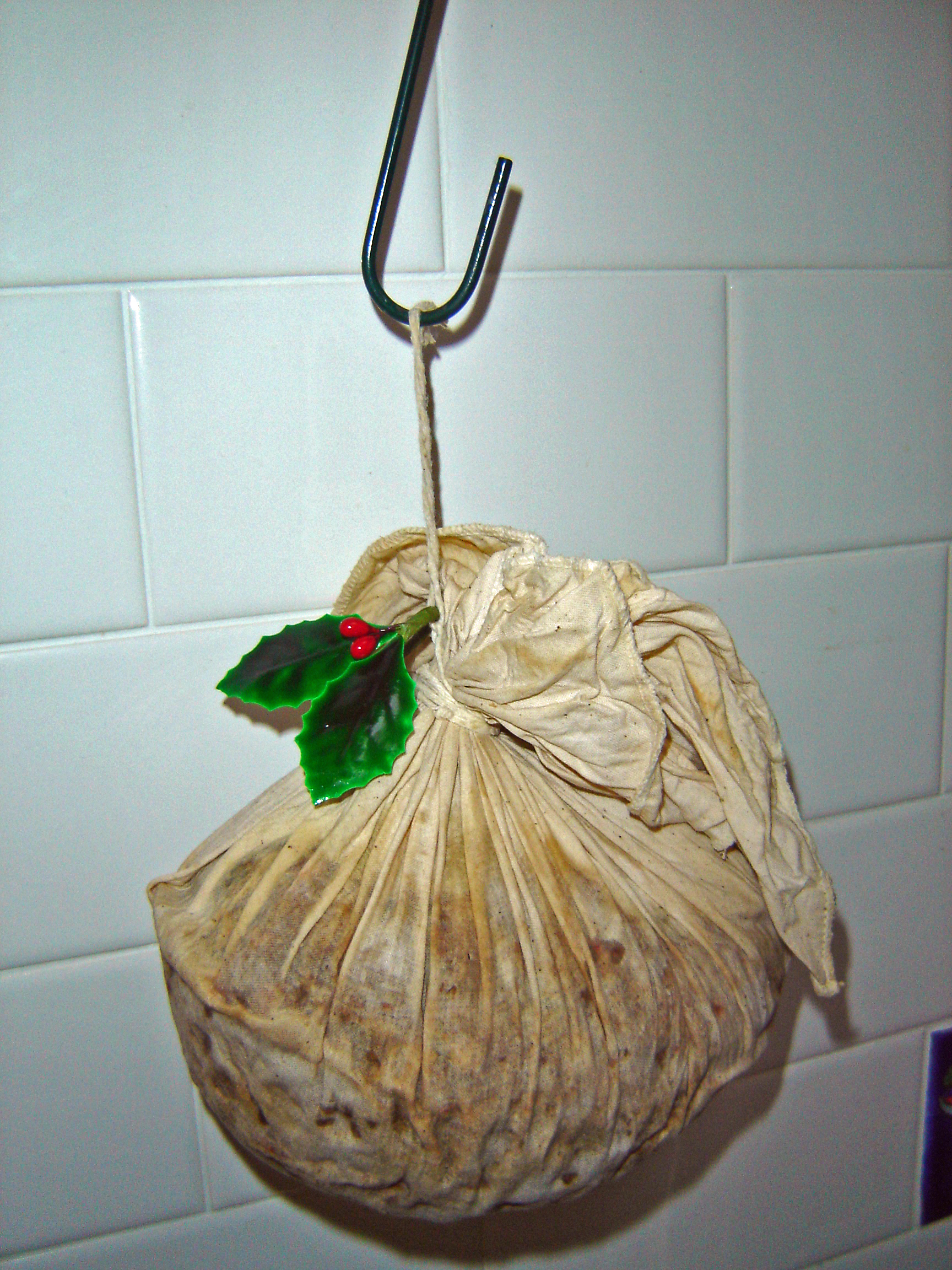
A Christmas pudding hanging on a hook to dry. Photographed by DO’Neil.
In the 18th century, pudding cloths arrived, supplanting the animal intestines that had been used before ( yes, better not to think about it…). The mixture would be left in a muslin cloth for some time, followed by a lengthy cooking process. This is when plum pudding began to acquire the spherical shape that we know so well today. It was generally eaten alongside beef, if you were well-heeled enough to afford it, of course.
The golden age of Christmas pudding
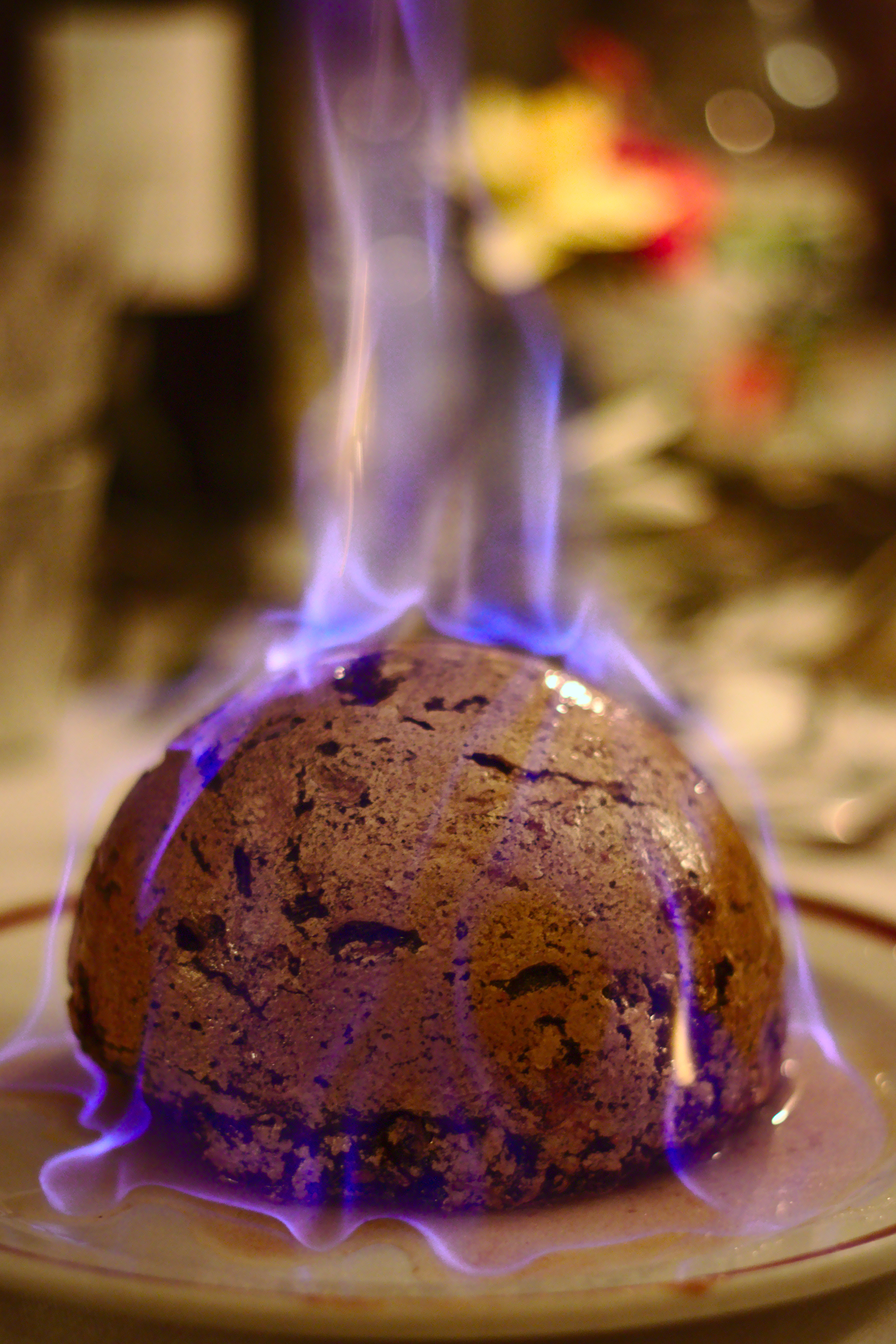
Fast-forwarding to the Victorian era, Queen Victoria and Prince Albert were known to enjoy lavish meals at Christmas, (see: https://wordpress.com/post/english-stuff.com/1197 ) with plum pudding often on the menu. Charles Dickens also promoted the idea of a Christmas pudding as a special delicacy at the end of A Christmas Carol when Mrs. Cratchit presents a sweet, round pudding, blazing in ignited brandy.
Two years after the publication of A Christmas Carol, our dish appeared as an official “Christmas pudding” in Eliza Acton’s Modern Cookery for Private Families, a bestseller in 1845. This was Christmas pudding as we would recognise it – that is, a round sweet pudding, with no beef, but plenty of fruit and spices. The pudding mixture could be moulded to give it a more ornate shape. It was however, still served alongside the meat course.
During the twentieth century, this sweet dish became exactly that – the dessert we instantly recognise, served with cream, custard or brandy butter. Supermarkets began to stock a convenient packaged version, which only needs to be heated and served.
But times continue to change. Nowadays many older Brits, (but certainly not all), are still attached to Christmas pudding, maybe because it has been part of our lives for so long. However, the younger generation, it seems, are not particularly supportive of the Christmas pud, probably as it usually follows a very rich and heavy first and second course. The Royal Mint in a 2024 survey found that a whopping 59% of the British population said they did not consider the Christmas pudding to be essential to the festivities. What do you think?
Christmas pudding has been with us in various guises for hundred of years. It is still cherished by some. But do you think Christmas pudding will survive in the future? Do youlove it or loathe it? Let me know!
English Stuff is a blog about the English language, culture and history, and we often feature posts about idioms in English – idioms being those linguistic gems of expressions that frequently don’t have a direct translation into another language, and they are often rooted in an interesting origin or piece of unusual history.
But today we’re going to turn it around and look at idiomatic expressions from other countries that would make no sense at all if they were translated into English.
France
La France Photo courtesy of Openverse.
Idiom – pédaler dans le choucroute
Literal translation – to pedal in sauerkarat. ( If you don’t already know, sauerkraut is a fermented cabbage dish eaten on the continent, and would definitely be a slippery, hazardous surface to travel on )
Real meaning – to go round in circles and get nowhere
If it existed in English – I explained it to him several times, but I was pedalling in sauerkraut.
Idiom – avoir la patate
Literal translation – to have the potato
Real meaning – to be full of beans (obviously English kids are fed baked beans whilst French kids enjoy gourmet carbohydrate)
If it existed in English – I can’t control these kids, they’re full of potato today.
Idiom – Poner un lapin
Literal translation – to put up a rabbit
Real meaning – to stand someone up
If it existed in English – She was supposed to meet me for dinner, but she put up a rabbit and never showed up.
Germany
The Bundesflagge! Photo Courtesy of Openverse.
Idiom – tomaten auf den augen haben
Literal Translation – to have tomatoes on your eyes
Real meaning – to be unaware of what’s happening around you
If it existed in English – She walked straight into a tree as she had tomatoes on her eyes.
Idiom – Wie eine beleidigte Leberwurst
Literal Translation – Like an offended liverwurst
Real meaning– someone who is offended very easily
If it existed in English – He acted like an offended liverwurst when I asked for his name.
Idiom – Es ist mir Wurst
Literal meaning – It’s sausage to me.
Real meaning – I don’t care one way or the other
If it existed in English – I’m not worrying about it, it’s all sausage to me.
Spain
¡Viva España! Photo courtesy of RawPixel via Openverse.
Idiom – se me ha ido la olla
Literal Translation – my pan has gone
Real meaning – to lose your marbles
If it existed in English – I was so exhausted that my pan went.
Idiom – vete a freír espárragos
Literal Translation – go away and fry asparagus
Real meaning – Get lost
If it existed in English – He spoke to me rudely so I sent him away to fry asparagus.
Idiom – tela marinera
Literal Translation – material for sails
Real meaning – this is very complicated
If it existed in English – Solving this problem is a nightmare, like material for sails.
These are a tiny, hand-picked selection of the immense amount of idioms out there,and they exist in practically every language. Idioms may have different literal translations but we can all relate to the concepts they express. Idioms are an illiustation of how we feel about situations in life, no matter where we are or which language we speak.
You may think that this post is somewhat late – surely carnivals take place in February around the time of Pancake Tuesday and Mardi Gras, don’t they ? Well, yes and no.
Carnival celebrations are huge in the Canary Islands, and Lanzarote very much adheres to this rule. Carnival is not programmed on fixed dates, but this year carnaval season began on 1st February, with festivities, concerts and events in the capital city of Arrecife….and will conclude a whole 6 weeks later (yes, 6 weeks.!!) on 10th March, ending with a week of parades and activities in the neighbouring island of La Graciosa, just north of Lanzarote.
Carnaval arrives in the small island of La Graciosa, north of Lanzarote, 2023
Parades, concerts,music and pageants
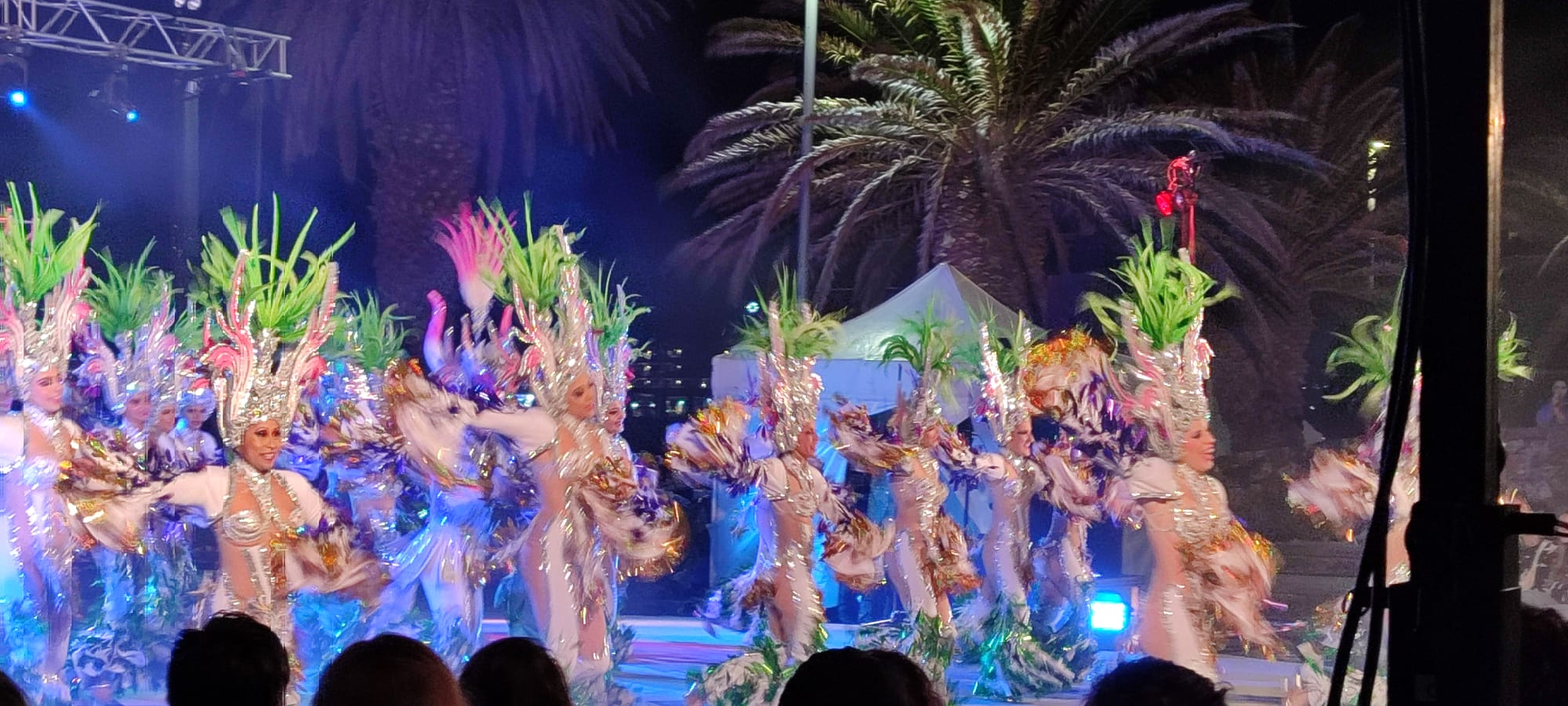
The local streets are buzzing with activity at this time of year, and residents and tourists alike join in the noisy celebrations. There are elaborate costumes, floats and live music, ranging from the more traditional Canarian music to the latest hits. For many of the locals carnaval is a bigger event than Christmas and many bystanders will be dressed in costumes simply to watch the culmination of events as the carnival procession passes by.
But there is more to all this than just music and dancing. Some carnival traditions are intertwined with social history in Lanzarote.
A bit of history from local towns
Arrecife
Los Buches de Arrecife, a long standing tradition. Photo – Ramón Pérez Niz.
In Arrecife, from the beginning of the 19th century, the bucheros, masked and dressed in old-fashioned peasant clothing, and masked, would playfully threaten the passersby with their “weapons”, (buches) which were fashioned from the inflated bladders of large fish……hmm, maybe not the most attractive thought. In the past, the bucheros would refuse to work on the ships in Arrecife during carnival season and were fed by the locals who would welcome them into their houses.
Despite opposition from the Church and the prohibitionof the bucheros dating from the Spanish Civil War in the 1930s until the 1960s, the bucheros are still “attacking” the carnival goers today…. albeit in a revamped costume seen above in the photo (and no longer using authentic fish bladders, you may be relieved to learn.)
Teguise
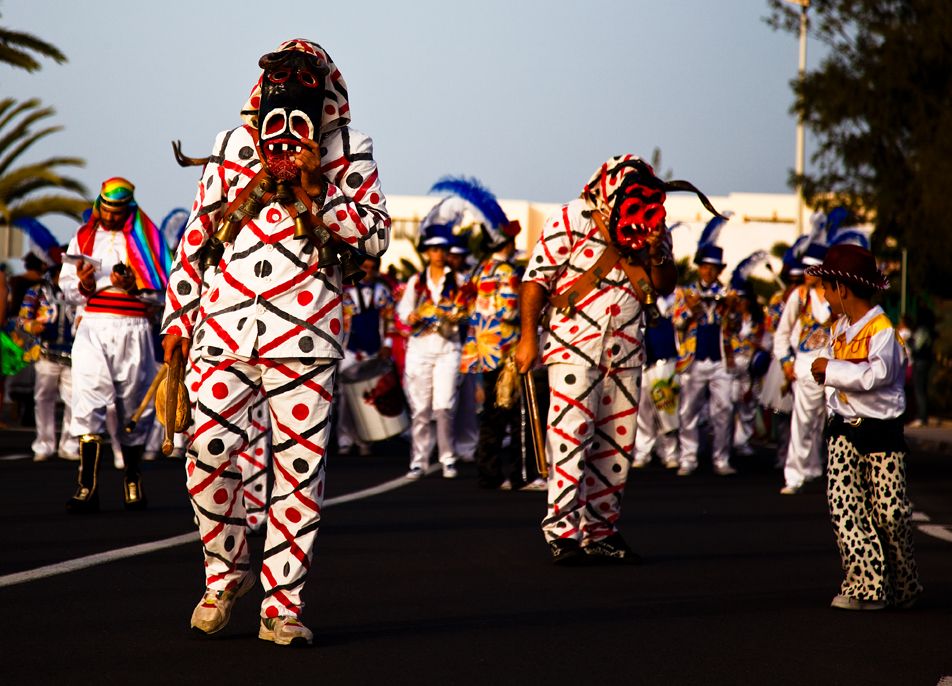
Los diabletes de Teguise – the little devils from the town of Teguise, the old capital of Lanzarote.
The use of devil images is widespread througout carnivals globally, and is often a mischevious figure attempting to cause mayhem. The diabletes (little devils) of Teguise are no exception, chasing and frightening the younger inhabitants.
Their distinctive costumes with their red and green diamonds, and their colourful masks, denote both their impish nature and also symbolise fertility/virility.
Carnaval in Lanzarote offers not only a great opportunity to enjoy the vibrant celebrations, but also a unique insight into the rich cultural heritage of this spectacular island.
Have you got Christmas on your mind? Thinking about food, gifts, entertainment? A thousand other details? The UK goes into overdrive about Christmas from the beginning of November, and some people are pretty fed up with Christmasness (yes, I know it’s not really a word) by the time 25th December finally rolls around. I sometimes felt like this when I still lived in England.
Although I’ve lived in Spain for several years, I’ll be celebrating Christmas for the first time in Lanzarote this year. While Christmas in Spain has lots of similarities with Britain – it’s family time, we eat lots of special foodstuffs and give each other presents, the monarch makes a speech – there are some differences too. And some of them may surprise you.
The run-up to Christmas
Spain has Christmas ads and commercials, but not to the same extent as the U.K. where everyone is bombarded with a huge retail campaign from 1st November onwards, and it is also not uncommon to see Christmas items on sale well before the winter months.
Over the years I have lived in Spain, the yuletide preparations have slowly increased in volume and the Christmas promotions have started a little earlier each year – but still not to the extent reached in Britain.
Christmas shopping in Arrecife, Lanzarote’s capital, early December 2023 -no crowds!
Life is not perfect here in Lanzarote, or anywhere else. But the laid-back island vibe helps to keep everyone relatively sane. And the mild winter climate and sunshine help, of course….were it not for the festive decorations. it would be hard to believe that it really is Christmas.
Christmas Eve/ Nochebuena
British Christmas fare
So you may already know that we have our family Christmas dinner in the evening in Spain, on Christmas Eve. And we don’t have a set meal, like in England, where a traditional Christmas dinner consists of a roast turkey, with all the trimmings, although it’s also true that nowadays more and more people are choosing an alternative menu which caters more to their taste.
Spain is a diverse country, with a rich gastronomy that varies from province to province. This is why the Christmas Eve (Nochebuena) menu tends to differ everywhere in Spain.
Roast turkey might be on the menu, particularly in the Balearic Islands or in Galicia, in the northwest of the country. But the main dish could be any type of roast meat (lamb and pork are popular choices) or fish or even shellfish, taking advantage of the availability of local delicacies.
A delicious salmon dish
In the Canary Islands, fish is often the star of the show, as the Canaries have access to a wide variety of delicious fish from the Atlantic – for example, cherne (wreckfish) or bocanegra (scorpionfish). Many species of tasty locally sourced fish are available, which are not generally found in other parts of Spain.
Slicing the ham takes a certain skill
And there’s always a wide range of tapas provided as extra nibbles. In the colder parts of Spain in the north (not talking Canaries here, obviously) broths and soups are often on the menu to start off the feast.
Other extras might include jamón iberico (cured ham), cheeses, small pastries, prawns and other types of seafood. In the Canaries papas arrugadas (wrinkled and salted boiled potatoes) with delicious sauces (mojos) are also likely to make an appearance.
In Spain we have many sweet treats during Christmas time, but one of the most traditional is turrón – a type of nougat made from honey and nuts which was popular from the Islamic conquest of Spain in 711. There were originally just two varieties
Turrón de Alicante – a rigid block of around 50% almonds plus honey and sugar.
Turrón de Jijona – this is nougat with a soft consistency, made from toasted crushed almonds and mixed with honey and egg whites.
In the photo above you can see turrón de Alicante third from the left on the second row. Turrón de Jijona is second from the left, first row.
Nowadays, apart from the original turrones, there are also many other varieties with a huge range of different flavours. The photo shows chocolate praline, glazed fruit, chocolate truffle and walnut, and rum and raisin, amongst others. Unfortunately these treats are probably not for anyone strictly watching their calorie intake.
The royal speech
And finally, a nod to the King’s speech, just like the UK. The only difference is that it’s always scheduled for 9pm on the evening of Nochebuena, at the same time as the family gathering… (oh, and it’s in Spanish, which you may have already guessed…)
Christmas Day/Día de Navidad
Christmas Day has a bit of a Boxing Day vibe, as everyone is recovering from the festivities the night before. But it’s still a bank holiday and an important day in the calendar.
A lot of Spanish people will go out for a special lunch to celebrate, and there are always eateries in holiday destinations which offer English Christmas dinners – although I would advise you to also sample some of the incredible gastronomy Spain has to offer.
The old Spanish tradition of receiving presents from the Three Kings on Epiphany, January 6th, is still going strong. However, with globalisation, and the practicality of children being able to enjoy their presents for the remainder of the Christmas holidays, gifts are given more and more on 25th December, although a lot of lucky Spanish kids will also receive another gift on January 6th from the Three Kings. We know these regal giftbearers as the Three Wise Men.
This post may have arrived just after Christmas Day, but wishing all our readers the very best for the rest of Christmas season.
Do you know of any more Christmas traditions in other countries which are totally different to Britain?
A simile is a phrase where we compare characteristics of one object to another, usually with the words like or as. For example:
You look as white as a sheet/ghost, what’s the matter?”
“He was so hungry that he ate the sandwich as quick as a flash.“
In these two sentences, the comparison is easy to understand – a sheet or a ghost is usually white, and a flash is swift. But some of these sayings do not always sound logical. Here are a few more that may need further clarification.
As bold as brass
Why do we use an alloy of copper and zinc, a.k.a brass, to say someone is bold? There’s a theory that attributes this phrase to Brass Crosby, who became the Mayor of London in 1770 and clashed with the establishment who were attempting to ban written reports on what had been said in Parliament. Crosby was unsuccessful in defending a printer who had published a parliamentary session and his bold actions caused him to be summoned before Parliament, and imprisoned for a time in the Tower of London. The public was outraged and Mr Crosby was released 6 weeks later. Since then proceedings in parliament have been reported without restrictions.
Although this is a remarkable story, and with apologies to Mr Crosby, it appears that as bold as brass was used before the 1770s. Brass comes from the same root as the word brazen meaning full of confidence and with little shame. However, the word bold is associated with a positive idea of bravery, while brazen usually transmits the idea of disrespect and shamelessness.
While it is undoubtedly advisable to keep your whistle free of bacteria, the original saying was actually as clear as a whistle. Over time the word clear became clean, and there we have it.
As fit as a fiddle
This simile was first used in the 1600s and that’s where we need to go to find out why we use this strange combination. In the 17th century, the word fit meant convenient or suitable, and it is used in this sense when we say fit for a king.
During the 20th century, we began to use the word fit as a way to describe our state of health and the simile has taken on this new meaning. But why a fiddle? Well, a fiddle (or a violin, the more formal term) was a common musical instrument 400 years ago and appropriate ( i.e. fit)for creating enjoyable music.
Of course, when we use this simile today, it’s to indicate someone is in great physical shape.
As easy as pie
I’ve made a pie or two, with varying degrees of success, and I wouldn’t say they are the easiest thing to make. However, the simile refers to the eating of pie, not the creation of it. I think we probably all agree that enjoying the pie afterwards is not a difficult task.
As mad as a hatter
A lot of people relate this simile to the Mad Hatter character in TheAdventures of Alice in Wonderlandby Lewis Carroll. But did you know that despite his fame as the Mad Hatter, the author only ever referred to the Hatter? There is little doubt that the Hatter’s behaviour was crazy, along with a series of other unhinged characters, such as the March Hare – also the owner of a simile – as mad as a March hare. This one came from the antics of hares during their mating season in March.
But back to the madness of hatters. It was well known in 1865 that hatters’ exposure to mercury, a component used in the manufacturing of hats, caused excitability and hallucinations, resulting in crazy behaviour. This type of mercury poisoning is formally known as erithismus mercurialis.
The Victorian era had very strict social norms that are alien to the world we live in today. Displays of emotion were frowned upon in public. Women were expected to stay chaste and innocent before marriage and had chaperones to ensure they did not breach social etiquette. Couples in romantic relationships were not given much privacy – they would communicate via handwritten letters or go on walks to be able to spend time alone. However, despite social codes of behaviour and respectability, people were still, well, people, and felt the same range of emotions that we can express freely today.
Floriography
Bearing in mind the restrictions of Victorian etiquette, it might not have been easy to approach your love interest, let alone hold a conversation. So messages in code were sent using flowers. Floriography – the language of flowers – was not limited to romance, flowers were also sent as a gift of gratitude or friendship, but it was commonly used to convey romantic concepts. Floriography peaked in popularity in Britain as well as France and the U.S. during the Victorian era.
Flowers and their special meanings allowed individuals to express their feelings discreetly in a world of propriety where direct expression of emotion was frowned upon in public.
Floral dictionaries
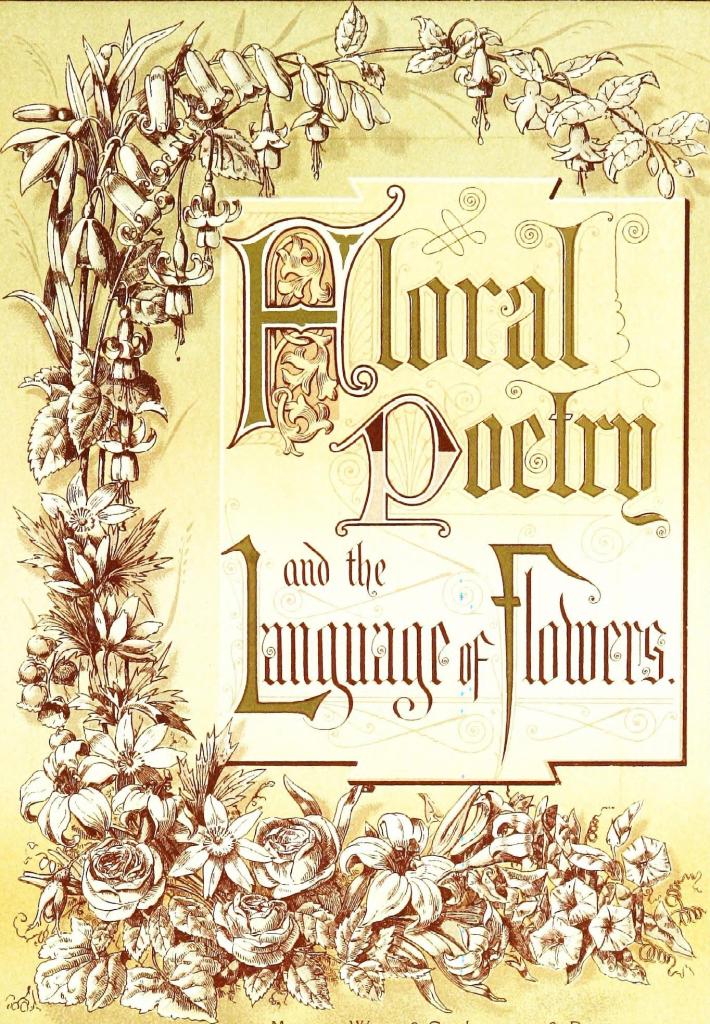
A Floral Dictionary from 1877 Internet Archive Book Images, No restrictions, via Wikimedia Commons
Coincidentally, this was also an era when there was a burgeoning interest in botany, and new publications described the different characteristics of flowers and plants in detail. Floriography was around long before the Victorian age and attributing specific meanings to flowers had been seen before in other periods and cultures – in Japan, Ottoman Turkey and the Hebrew Bible, for example.
But back to the Victorian era. In this period, florists saw their businesses boom, alongside the creation of floral dictionaries, like the one shown above. One of the most famous was The Language of Flowers by Kate Greenaway, published in 1884, and shown below. This book is actually still on sale on the Amazon website today.
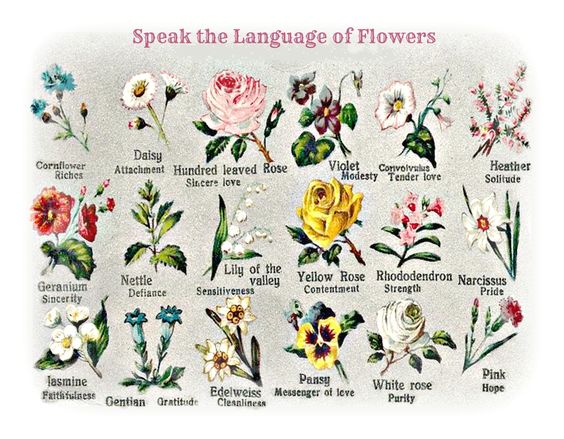
There were several dictionaries of this type by the beginning of the 1900s, so often the flowers were a symbol for more than one concept. An anemone, for example, could mean hopeless love, or anticipation. A combination of flowers could convey a more complex message, and the arrangement of the flowers was also significant. The intended message could be changed by just a small variation in the bouquet. It all seems intriguing and kind of fun. No wonder the floral dictionaries were flying off the shelves.
The flowers were grown in English gardens so were generally seasonal – roses, daffodils, chrysanthemums and delphiniums were popular. Roses expressed the idea of love but its colour added nuance to its significance. Daffodils could mean prosperity, loyalty or new beginnings. Chrysanthemums expressed friendship, and delphiniums dignity and rebirth. Sweet pea flowers were often chosen to show gratitude for hospitality. Confused? It’s not hard to see why flower dictionaries were popular – the interpretation of a Victorian bouquet was possibly not a simple task. The images below convey more ideas the flower sender might wish to express.
It was also meaningful where the recipient placed or wore the flowers after their delivery. To quote J.B. Meadow:
A woman also had to be pretty precise about where she wore flowers. Say, for instance, a suitor had sent her a tussie-mussie (a.k.a. nosegay). If she pinned it to the ‘cleavage of bosom’, that would be bad news for him, since that signified friendship. Ah, but if she pinned it over her heart, ‘That was an unambiguous declaration of love’.
The colours of the chosen flowers were also imbued with meaning.
Red – passion, devotion
Yellow – affection, fondness
Blue – loyalty, truth, dignity
White – purity, innocence
Pink – appreciation, elegance
Orange- enthusiasm, good wishes
Decline of Floriography
In the 1900s, as society gradually began to relax its strict rules of social etiquette and with advances in technology which improved communication, the need for flower messages began to disappear. With the start of World War One, the laborious process of cultivating the flowers was abandoned as other priorities came to the fore.
Some of the strongest associations with flowers have stayed with us until today – red roses still signify passion, poppies are a symbol of those lost at war, and lilies represent purity.
And a gift of flowers is still a beautiful present which generally conveys some type of sentiment from the sender – love, sympathy, congratulations, friendship. Maybe next time you send or receive flowers, spare a thought for the Victorians and their floral dictionaries.
Most people know Lanzarote these days as a popular British holiday destination in the Canary Islands, but the island has survived its share of tragedy and suffering. In the 1700s volcanic eruptions shook Lanzarote and destroyed much of the agricultural land, the island’s principal activity.
The situation was disastrous for many local inhabitants, who were forced to emigrate, mainly to Cuba and the Americas. In the following years to come, there would be periods of drought, food shortages, epidemics and more volcanic activity. This produced a wave of emigration that lasted until the 1950s.
It is possible that Carlos Gutierrez was one of these emigrants. Not much is known about Carlos – his birthplace is debated, but no matter if he was born in Lanzarote or Cuba, Carlos would have grown up around the sea, and been familiar with both Atlantic waters and the Gulf Stream winds. As an older adult, in the 1930s, he became a fishing mate of Ernest Hemingway the writer, who was also living in Cuba at the time.
Hemingway and Pilar
Hemingway, a keen angler, had acquired a 12-metre boat in 1934 and named it Pilar, a name he used for his second wife, Pauline. The boat was used for sailing and fishing trips around the Caribbean. Carlos Gutierrez became the first captain onboard Pilarfor Hemingway, whose passion for the sea would have a strong influence on his writing.
Ernest Hemingway (left) and Carlos Gutierrez (right) onboard Pilar. Photograph in the Ernest Hemingway Photograph Collection, John F. Kennedy Presidential Library and Museum, Boston. Author unattributed.
During fishing expeditions prior to the purchase of Pilar, Carlos had taught him techniques for catching marlin, a species related to swordfish, but with a crest and a long spear-like jaw. Marlin fish, large bony fish, weighing up to 450 kg, were fished by Hemingway in Florida, the Bahamas and Cuba, but they were also well-known in the Atlantic waters surrounding Lanzarote. The photo below shows Ernest, Pauline and sons, along with some unfortunate marlin, in Birmini, on the west of Bermuda, where the family lived from 1935 to 1937.
Pauline, Patrick, Ernest, John, and Gregory Hemingway with four marlins on the dock in Bimini, 20 July 1935. Ernest Hemingway Collection/John F. Kennedy Presidential Library, Boston.
There is no doubt that Hemingway was an excellent angler and that much of his time was dedicated to fishing. But according to Jeffrey Meyers who wrote a biography of Hemingway in 1985, his boat was also a
”kind of a floating whorehouse and rum factory as well as a fishing boat.”
So it would seem Hemingway got his kicks in other ways on Pilar and this would eventually lead to Carlos’s downfall. Sources say Carlos Gutierrez was sacked by Jane Mason, Hemingway’s mistress at the time, when she discovered that Ernest was spending time onboard with Martha Gelhorn, who would eventually become his third wife. He was still married to Pauline at the time.
So Martha replaced Pauline and Jane, and likewise, Carlos Gutierrez’s role was filled by Gregorio Fuentes.
Gregorio Fuentes
We know for sure that Gregorio Fuentes was born in El Charco de Ginés, in Arrecife, the capital city of Lanzarote, in the 1890s. He is said to have emigrated to Cuba at the age of 6 with his father, who sadly did not survive the voyage. It was all too familiar for passengers to die during the journey due to either lack of sanitary conditions, tropical diseases or a combination of both. On arrival, young Gregorio was taken care of by other passengers from the Canary Islands who were also emigrating to Cuba. Another source says he migrated to Cuba permanently at the age of 22, after working in the Canaries, Valencia and Seville on the docks.
There are also conflicting stories on how Gregorio met Hemingway, but one thing is clear – they were bonded by their love of the sea. Legend says that Gregorio, who at the time captained another boat, saved Hemingway and his crew from a tropical storm in 1928. It is indisputable that Gregorio and Ernest established a lasting friendship after Ernest established himself in Cuba in 1939, and Gregorio worked on the deck of Pilar, eventually replacing Carlos as captain. They would go out on fishing expeditions that lasted 3 or 4 days and any further details of what happened onboard were never divulged by Gregorio.
Andy García, the Cuban American actor, in collaboration with HilaryHemingway, Ernest’s niece, has written a screenplay of this friendship although the film appears to have remained in a developmental stage for several years.
Poster for the Hemingway and Fuentes film, still in production. The photographic image is authentic.
The Old Man and the Sea
By 1961, Hemingway had married his fourth wife Mary, won the Pulitzer Prize for The Old Man and the Sea, was awarded the Nobel Prize for Literature and moved back to the States, where he committed suicide after bouts of physical illness and depression. He left his boat Pilar, home of so many fishing expeditions, to his staunch ally Gregorio, who in turn left it to the Cuban people. The boat is still on display in Havana.
The Old Man and the Sea was Hemingway’s last major work of fiction, written in Cuba in 1951. It recounts the story of Santiago, an ageing Cuban fisherman who has an epic battle on his fishing boat to catch a giant marlin, with themes of perseverance and suffering.
Gregorio is often cited as being the model for Hemingway’s protagonist, Santiago, although it also seems highly probable that Carlos Gutierrez, Pilar’s first captain and master fisherman, would have provided Hemingway with both inspiration and expert knowledge of how to catch marlin. Hemingway himself claimed that Santiago was not based on anybody. Gregorio, in later life, was known to charge tourists in Cuba for tales of his friendship with Hemingway, and these memories often emphasised his links to the hero of The Old Man and The Sea.
What cannot be denied is that the world-renowned Ernest Hemingway and this humble fisherman born in Lanzarote forged a deep friendship of over 20 years, bound by their passion for fishing and the sea.
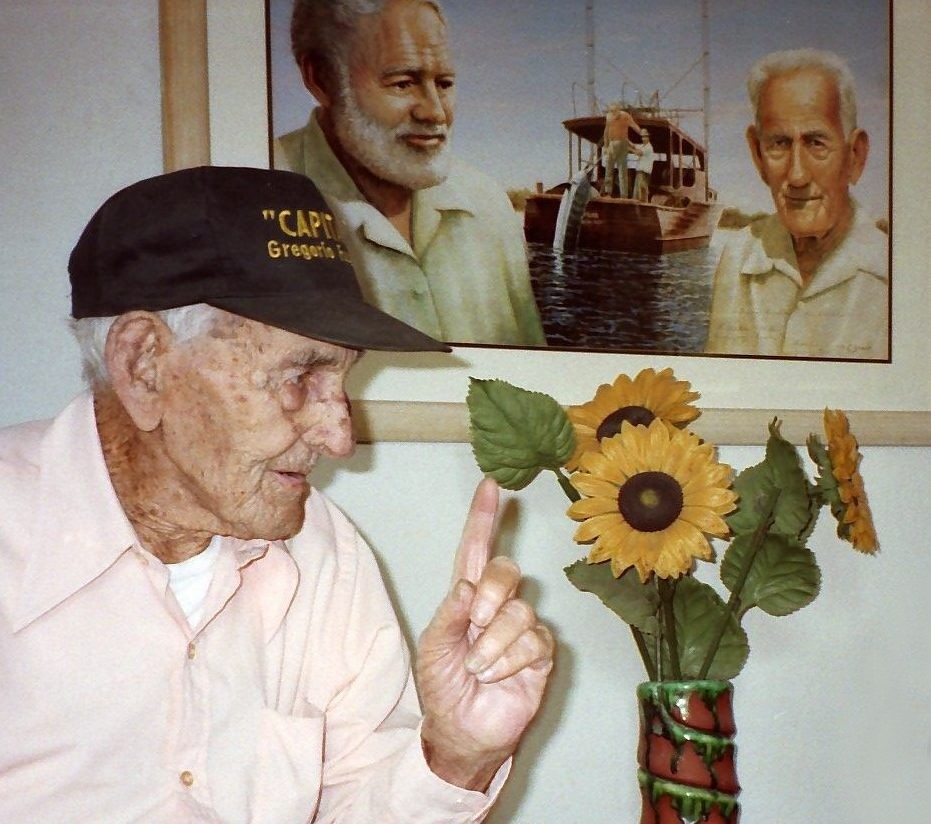
Gregorio Fuentes lived in his adopted hometown of Cojimar in Cuba until the grand old age of 104. He died in 2002, having never read The Old Man and the Sea for himself, as he was never taught how to read.
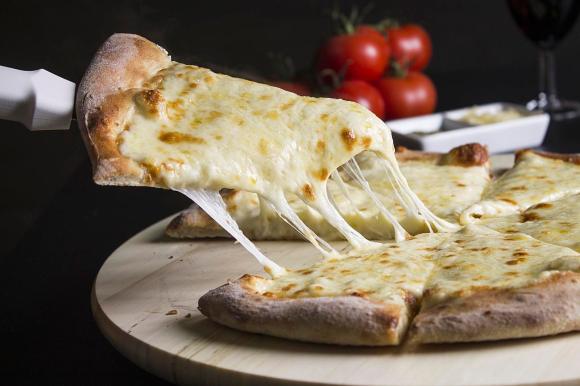
We say that something is cheesyin English to mean that it is inferior, cheap or possibly embarrassing due to its lack of quality. (Obviously, this does not apply to its other definition, i.e. a large amount of cheese on our food, as above!)
Examples:
He bought some cheesy (tacky) souvenirs from the local shop.
We didn’t like the show, the actors were really cheesy. (phoney)
But this was not always the case. In the 1850s, when the word was first used, if something was cheesy it was considered to be of top quality. Cheesy as the idea of something pleasant and important crossed the Atlantic where the concept of cheese meant celebrity or big money and gave us the expression ” the big cheese” to signify a person of importance. Over time, the word cheesy began to be used ironically, and this is the meaning that we have been left with today.
Small Potatoes/Chickenfeed
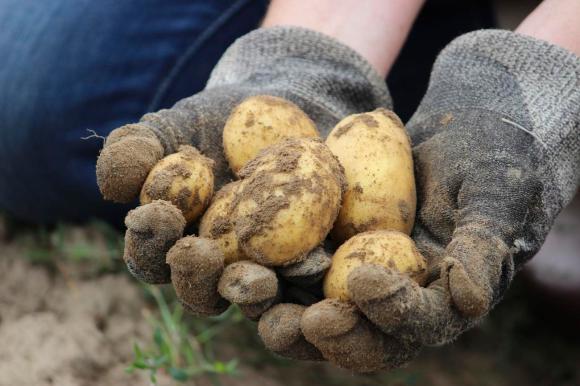
Small potatoes are the opposite of important, something, not very imposing and insignificant. First recorded in the 19th century, it came from the idea of small potatoes not being worth the bother if they were being picked or sold.
Chickenfeed, another U.S. expression, is along the same lines. Chickens were readily available in the 18th and 19th centuries whereas cattle and horses were more expensive and needed a bigger supply of food.
Chickens, being lower down the pecking order (see what I did just there?) were fed on leftovers and grain, hence chickenfeed coming to mean something trivial, often a small amount of money.
Examples:
I’m not interested in their money – it’s small potatoes/chickenfeed.
Sour grapes
If you suffer from sour grapes, it means you speak badly of something you cannot have. This is an expression from one of Aesop’s Fables.
Aesop was a slave who lived in Greece around 600 B.C.E. He was a storyteller who told fables – short stories with a moral at the end. These fables were not recorded until 300 years after his death, so Aesop’s Fables, the collection of his stories, may or may not be all his own work, as the stories have been recorded, translated and rewritten over hundreds of years.
However, one of the best-known tales is “The Fox and The Grapes”, in which a fox is unable to reach a juicy bunch of grapes. Disappointed by failure, she salvages her pride by saying that they must have been sour.
I’m sure you can all think of someone who disparages something they once wanted. This is a case of sour grapes.
Salad Days
This saying refers to a carefree time with no worries, generally when we are young, and it was first recorded in William Shakespeare’s play Anthony and Cleopatra.
Cleopatra calls her salad days the time when she was “green in judgement“, in other words, she was naive with not much knowledge of the world.
For a time this was also what people meant when they referred to salad days but the meaning has now shifted to mean the prime of youth, a time of happiness and optimism.
Example:
He did lots of crazy things in his salad days, but now he’s turned into a typical family man.
Thanks for reading the post! Can you think of any more foodstuffs used in English expressions? Write them in the comments below!
























 english-stuff.com

You must be logged in to post a comment.