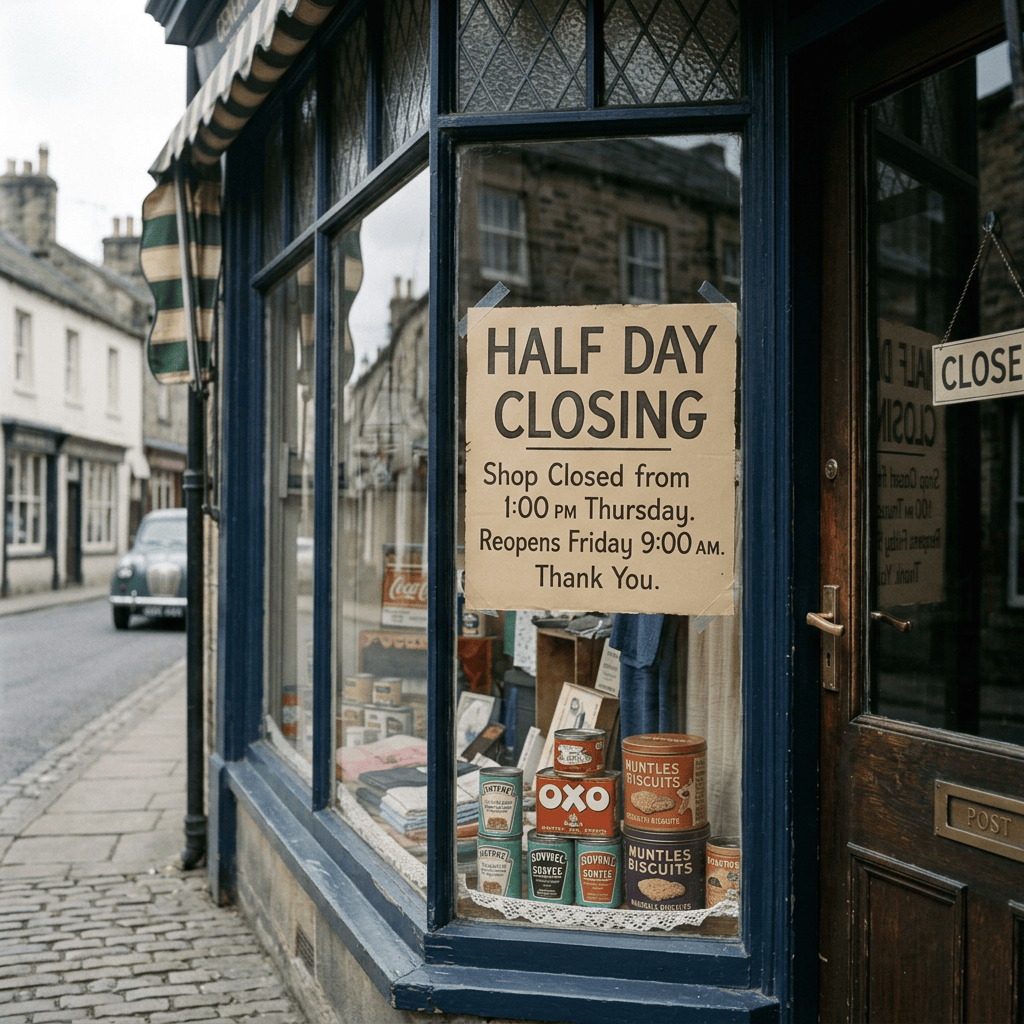

There was a time when going shopping on a Wednesday afternoon could be a rather disappointing experience.
As a child, I remember that many of the local independent shops in my area closed for one afternoon every week. If you needed something from the local shopkeeper, you had to get there before the shop closed early or wait until the following day. Fancy some chocolate at 12.45 on a Wednesday? You had to run to the sweet shop before the door was firmly closed at one o’clock. Your favourite comic came out on Wednesdays? Make sure to buy it in the morning or you had to wait until Thursday.
The city centre, as far as I remember, was a different story. Shops there carried on trading, while the smaller neighbourhood shops took their weekly half-day break.
It was simply part of life. Nobody seemed particularly surprised by it, and shopping had to fit around the opening hours of the shops rather than the other way round.
But why Wednesday? And whatever happened to this once-familiar British custom?
Half-day closing
Half-day closing was not just a tradition; it was backed by legislation. The Shops Act 1912 required shops, subject to certain exemptions, to close to customers by one o’clock on one weekday each week.
Its primary purpose was to improve shop workers’ conditions by giving them a regular half-holiday during the working week. Some shopkeepers used this break for stocktaking or dealing with wholesalers.
Local councils stipulated the day so none of the shops had an unfair advantage. In many areas the shops closed on Wednesday afternoon, but there were some places where they opted for Thursday, and sometimes even Tuesdays. Market towns tended not to choose the day that the market was held – closing the shutters on a day when the town was already flooded with farmers, traders and rural shoppers would have been financial suicide.
This created an incredibly localised calendar. For example, Beverley in Yorkshire, held its livestock market on Wednesdays in 1966, with shops closing on Thursday afternoons. Such local differences meant that shoppers sometimes had to remember not just when shops closed, but where they were shopping.
Each to his own timetable
Because these decisions were made by local borough councils, the boundaries between towns created some truly bizarre retail twilight zones. If you lived on the border of two different districts, a simple walk across the street could transport you into a completely different time zone of commerce, with shop doors wide open on one side, and shops in darkness on the other.
Not bound by early-closing
Early closing was not compulsory for every business. In 1950 a newer Shops Act decreed that some types of businesses were not obliged to close. The Shops Act 1950 listed exemptions for certain types of businesses. Here is a small selection, with a link to the full list.
- The sale by retail of intoxicating liquors.
- The sale of refreshments, including the business carried on at a railway refreshment room.
- The sale of motor, cycle, and air-craft supplies and accessories to travellers.
- The sale of newspapers and periodicals.
- The sale of meat, fish, milk, cream, bread, confectionery, fruit, vegetables, flowers, and other articles of a perishable nature.
- The sale of tobacco and smokers’ requisites.
- The business carried on at a railway bookstall on or adjoining a railway platform.
- The sale of medicines and medical and surgical appliances.
- Retail trade carried on at an exhibition or show, if the local authority certify that such retail trade is subsidiary or ancillary only to the main purpose of the exhibition or show. https://www.legislation.gov.uk/ukpga/Geo6/14/28/schedule/FIRST/enacted
So you could still buy, amongst other things, a beer, a bunch of flowers and your medicine.

Why were the city centres different?
City centre shops
Retailers in bigger cities often had sizeable workforces. Larger retailers had more staff and could organise working hours differently, allowing some shops to remain open while employees took their weekly half-holiday, by creating staggered staff rotas. Individual workers were often allocated their mandatory afternoon off on different days of the week while the business kept its doors open six days a week.
Local shops
Independent shops and family-run businesses did not usually have a large team of workers, maybe even just the owner and an assistant. A common way for small shops to apply the legislation was to close the shop for an afternoon.
Why did half-day closing disappear?
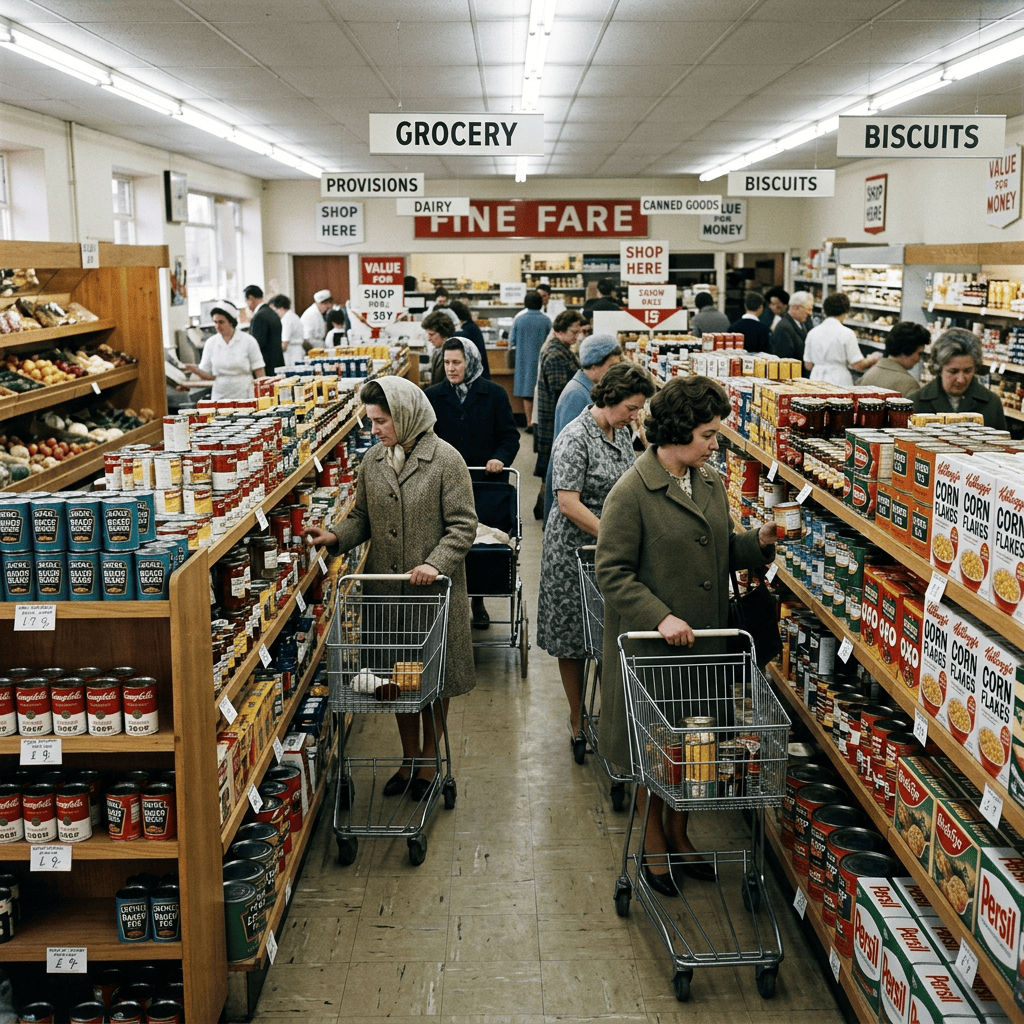
In the 1960s supermarkets became increasingly common, offering groceries altogether under one roof. They had plenty of personnel to enable a staggered staff rota and remain open while individuals took time off.
Other changes were transforming everyday life, too. Improvements in refrigeration meant that households could keep fresh food for longer, while rising car ownership made it easier for people to travel further to shop and bring home larger quantities of groceries.
The law changed as well. The Shops (Early Closing Days) Act 1965 allowed individual shopkeepers to choose their own early-closing day rather than having it determined by the local authority. However, it did not abolish the requirement to close early. That requirement remained until the relevant legislation was repealed in 1994.
Today, the idea of finding your local high street closed on a Wednesday afternoon seems almost unthinkable. We’re used to shopping whenever we like, whether that’s seven o’clock in the evening or seven o’clock in the morning, without even leaving the house.
But perhaps those Wednesday afternoons tell us something about a time when life moved at a slower pace. Shops closed, shopkeepers had a well-earned break and customers simply planned around it. It was a system shaped by strong local traditions. Occasionally inconvenient, it gave the working week a rhythm of its own.
We’ve certainly gained convenience, but have we lost something along the way?

And I wonder if anyone else remembers racing to the sweet shop before one o’clock on a Wednesday afternoon!


You must be logged in to post a comment.