
Macbeth’s First Performance, August 1606
On the evening of 7 August 1606, the halls of Hampton Court Palace glowed with candlelight. The Great Hall, hung with rich tapestries, was filled with the rustle of silks and the low murmur of voices as courtiers found their seats. Outside the palace walls, England still trembled in the wake of the Gunpowder Plot, a failed attempt to assassinate the king and topple his fragile new dynasty. Inside the hall anticipation hung in the summer air: Shakespeare’s company was about to unveil a brand-new play.
This performance was no ordinary entertainment. Written in haste, sharpened by politics, and laced with supernatural dread, Macbeth was carefully tailored for its royal audience – King James I, the Scottish monarch who had inherited the English throne just three years earlier. Shakespeare knew his patron’s obsessions: the divine right of kings, the dangers of treason and a personal fascination with witchcraft. The play that would unfold that night would flatter, warn and captivate in equal measure.
As the actors prepared to summon thunder and witches onto the stage, few in the room could have guessed that they were about to witness the birth of one of the greatest tragedies in the English language – a story of vaulting ambition and bloody consequence that still grips audiences four centuries later.
🏰 The Backdrop: England in 1606
When Shakespeare’s players stepped onto the stage at Hampton Court, the court was still haunted by the spectre of treason. Only months earlier, in November 1605, the kingdom had narrowly avoided catastrophe when a band of Catholic conspirators attempted to blow up Parliament and kill King James I in what became known as the Gunpowder Plot. The king had survived, but the shock lingered. England was jittery, suspicious and deeply aware of the fragility of peace.
James himself was still a relatively new monarch on the English throne. In 1603 he had inherited the crown from Elizabeth I, uniting Scotland and England under a single ruler for the first time. His accession had promised stability after the long Tudor age, but it had also brought unease. James was a foreign king to the English, unfamiliar in manner and accent, and he faced the constant challenge of proving his legitimacy.
This was the tense world into which Shakespeare offered his new tragedy. Macbeth was no simple tale of murder and ambition. It was a mirror held up to a kingdom still recovering from conspiracy, where questions of loyalty, kingship and divine authority were painfully fresh.
🎭 Why Macbeth? Politics Meets Theatre
Shakespeare was no fool. He knew that a play performed for the king had to do more than entertain; it had to flatter, reassure and, if possible, speak to the monarch’s deepest concerns. Macbeth was crafted with this purpose in mind, weaving together themes that aligned perfectly with King James I’s interests.
First was the matter of ancestry. James traced his royal line back to Banquo, the noble companion of Macbeth in Scottish legend. In the play, Banquo is portrayed as virtuous and unjustly murdered, while his descendants are prophesied to inherit the throne. For James, this was more than a clever plot point – it was a theatrical confirmation of his right to rule, projected in flickering candlelight before the entire court.

Then came the witches. James had a personal fascination with witchcraft, even publishing his own treatise on the subject, Daemonologie, in 1597. He believed witches had conspired against him, and his fear of the supernatural was well known. By placing three sinister witches at the heart of the story, Shakespeare tapped directly into his king’s obsession,blending entertainment with a subtle nod to James’s authority as the man who could confront and defeat such dark forces.
Finally, the play was a stark warning against regicide. In the wake of the Gunpowder Plot, England needed no reminder of the dangers of treason. Yet Macbeth drove the point home with visceral clarity: the murder of a king unleashes chaos, guilt and ruin, while the rightful line of succession endures. For James, it was a political reassurance staged as gripping drama.
In short, Macbeth was more than a tragedy. It was a play of loyalty and legitimacy – a performance that fused Shakespeare’s genius with the anxieties and ambitions of his age.
⚡ The Performance: Sights, Sounds, Sensations
As the candles dimmed and the first lines echoed through Hampton Court’s Great Hall, the audience would have felt a chill that had little to do with the summer air. Shakespeare’s actors conjured a storm with the crude but effective stagecraft of the day – rolling cannonballs to mimic thunder, rattling sheets of metal for lightning, stamping feet to suggest the earth itself trembling. Out of the shadows emerged the three witches, hissing their riddles and chants. For a court still haunted by whispers of real sorcery and conspiracy, the effect must have been spine-tingling.
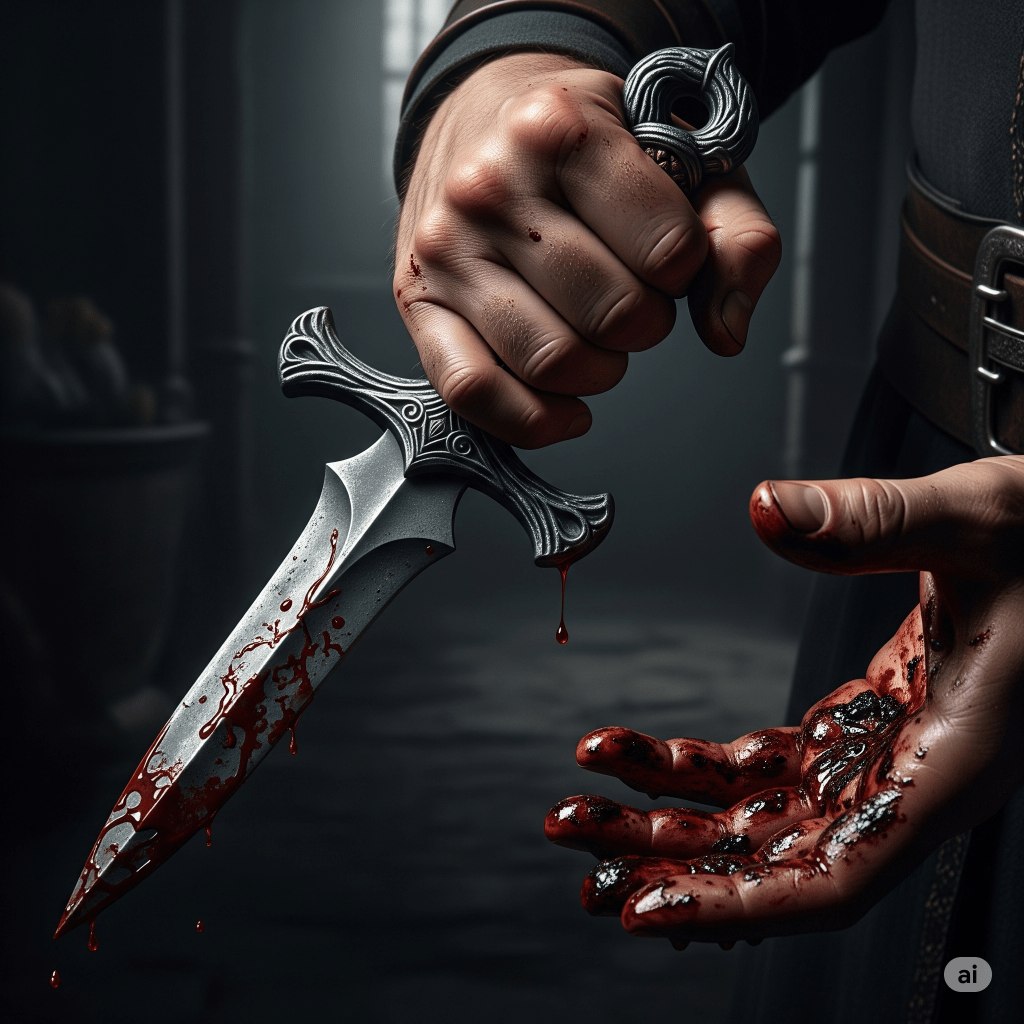
The action unfolded with a pace and brutality that set Macbeth apart from Shakespeare’s earlier histories and comedies. The murder of Duncan, though never shown on stage, was made palpable through the imagery of blood-stained hands, daggers that seemed to hover in the air and Macbeth’s tormented soliloquies. The courtiers would have watched in uneasy silence, perhaps casting sidelong glances at James himself during scenes of treason and regicide.
The performance was intimate, too. Unlike the bustling Globe Theatre, where audiences of commoners shouted and jostled in the pit, this was a royal performance in a confined, candlelit space. Every whispered line, every flick of a dagger, every flicker of flame would have carried weight. The courtiers were also participants in a carefully staged ritual of power, loyalty and warning.
By the time Macbeth fell and Malcolm reclaimed his throne, the message was clear. Kingship was sacred, rebellion doomed, and order would prevail. Just the reassurance King James wanted to hear. Yet beyond its politics, the play had cast a darker, deeper spell, one that would outlast monarchs and dynasties.
🌒 Legacy and Influence
That August night at Hampton Court was only the beginning of Macbeth’s long life. What began as a performance tailored for a king soon became one of Shakespeare’s most enduring tragedies, staged in playhouses, palaces and eventually on screens around the world.
Its themes of ambition, tyranny, and fate proved timeless. Though written to flatter James I, Macbeth transcended its political moment. Audiences saw in it not just a sermon on loyalty but a haunting exploration of the human hunger for power and the ruin it brings. From Cromwell’s England to the Victorian stage, from modern theatres to classrooms today, the “Scottish play” continues to resonate wherever people wrestle with corruption, violence and guilt.
Over the centuries, Macbeth also gathered a reputation as a cursed play. Actors whispered that disasters stalked its productions, from accidents on stage to mysterious deaths in the cast. Some blamed the witches’ spells, said to be real incantations lifted from folk magic. Others thought its violent energy simply courted misfortune. Whatever the truth, the legend only added to the play’s mystique, ensuring that its power to unsettle extended far beyond its script.
In this way, the candlelit performance of August 1606 became more than a royal entertainment. It was the spark that ignited over four hundred years of fascination, fear, and admiration. In short, a tragedy that once summoned, could never be banished back into silence.
🔮 Macbeth‘s enduring spell
Macbeth has never truly left the stage. Its witches still unsettle, its daggers still gleam, and its questions about power and fate are just as urgent today. What began as a carefully crafted performance for King James has become a universal tragedy, performed and reinterpreted for centuries.
Every August, when we look back at this moment in English history, we glimpse not only a king and his court but the birth of a story that still speaks to us across four hundred years, A reminder that unchecked ambition can unravel even the mightiest of crowns. A message still relevant today.


 english-stuff.com
You must be logged in to post a comment.