Categories
English history The Victorians

The History of Christmas Pudding: A Timeless Tradition

Sweet Christmas

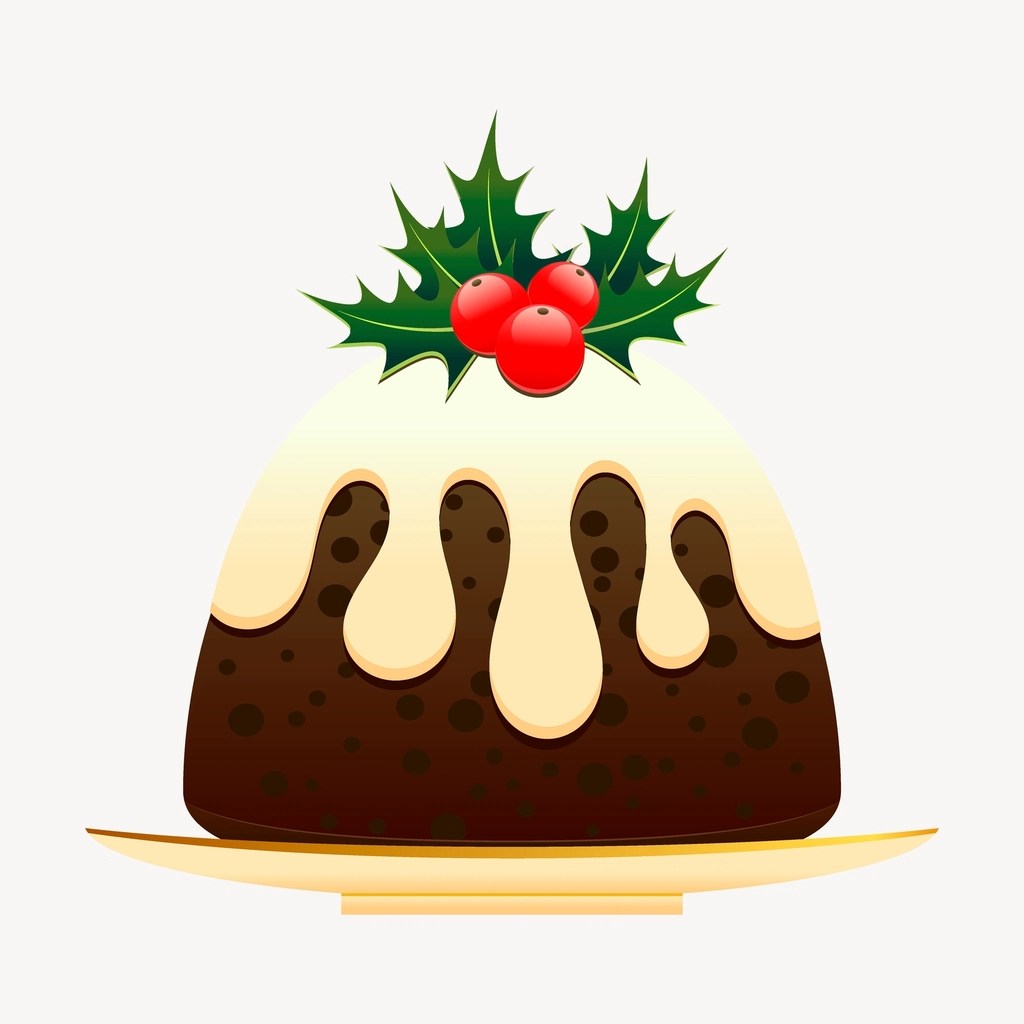
A Christmas pudding is a British emblem of Yuletide. Love it or loathe it, no traditional British Christmas meal is complete without one. Similar to Brussel sprouts, (which tend to be more loathed than loved but also still make an appearance) our Christmas dessert, in my humble opinion, is part and parcel of the Christmas festivities.

Our beloved Christmas pudding has history – it’s been around for longer than you might think.

Who made the first Christmas pudding?

Sadly, we do not know the name of the person who invented our pudding. But we do know that its forerunner, a type of pottage, a mixture of beef, suet, dried fruit and spices existed in England in the Middle Ages. Pottage was the name for a soupy kind of stew, generally eaten by peasants, and comprised of ingredients that were readily available to them – mainly vegetables and pulses. If the nobility chose to eat pottage, then more expensive items such as spices and meat would be included.

Many pottages later, around the end of the Tudor era, our pudding gained a more solid form, and a new name, plum pudding, but beef still figured amongst its ingredients. It was also a possibility that there were actually no plums in the pudding, plum being used to refer to various different fruits. At the same time the humble pottage was also still in existence and no doubt the size of your wallet would decide which version you chose.
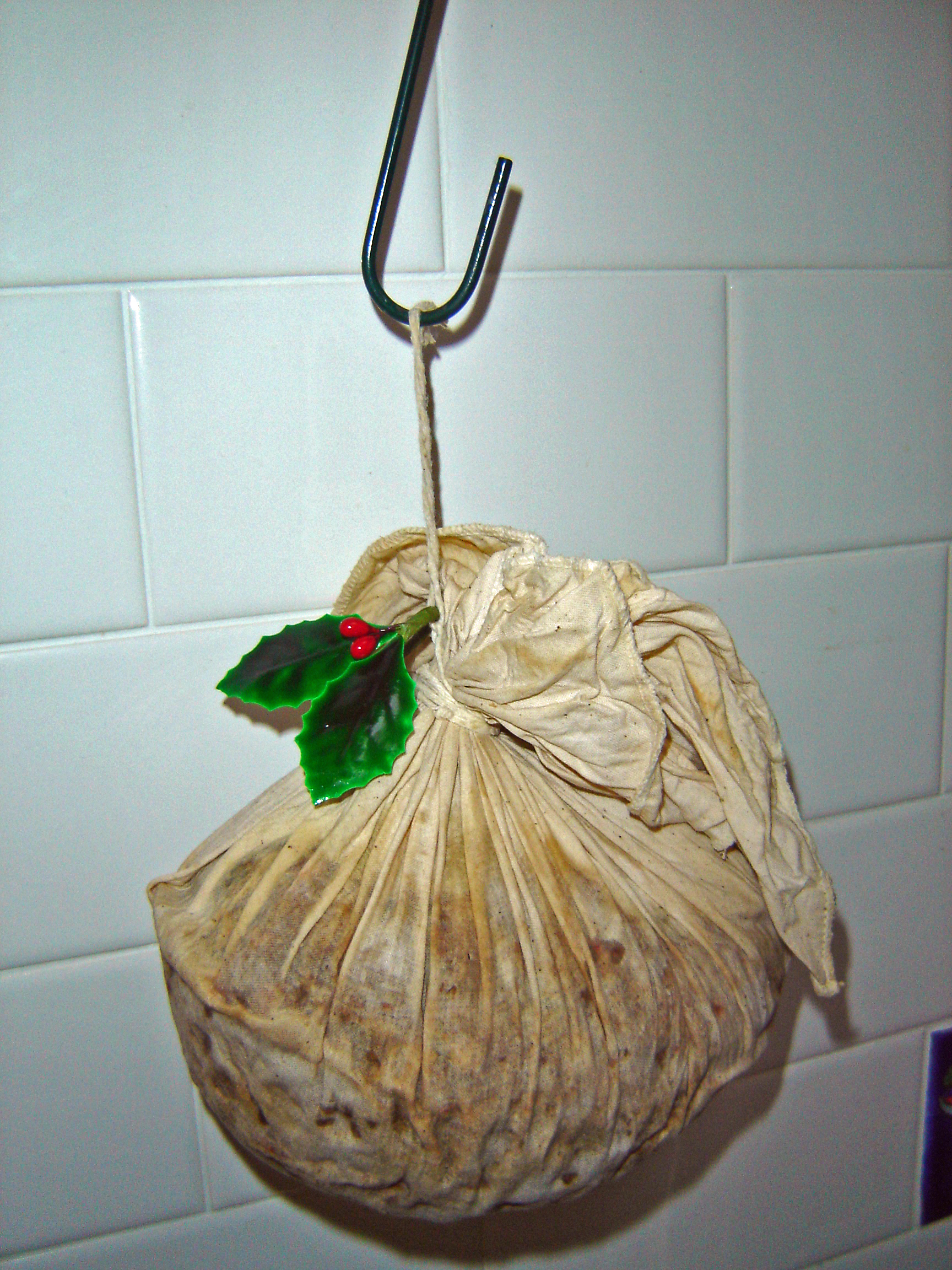
A Christmas pudding hanging on a hook to dry. Photographed by DO’Neil.

In the 18th century, pudding cloths arrived, supplanting the animal intestines that had been used before ( yes, better not to think about it…). The mixture would be left in a muslin cloth for some time, followed by a lengthy cooking process. This is when plum pudding began to acquire the spherical shape that we know so well today. It was generally eaten alongside beef, if you were well-heeled enough to afford it, of course.

The golden age of Christmas pudding

Fast-forwarding to the Victorian era, Queen Victoria and Prince Albert were known to enjoy lavish meals at Christmas, (see: https://wordpress.com/post/english-stuff.com/1197 ) with plum pudding often on the menu. Charles Dickens also promoted the idea of a Christmas pudding as a special delicacy at the end of A Christmas Carol when Mrs. Cratchit presents a sweet, round pudding, blazing in ignited brandy.
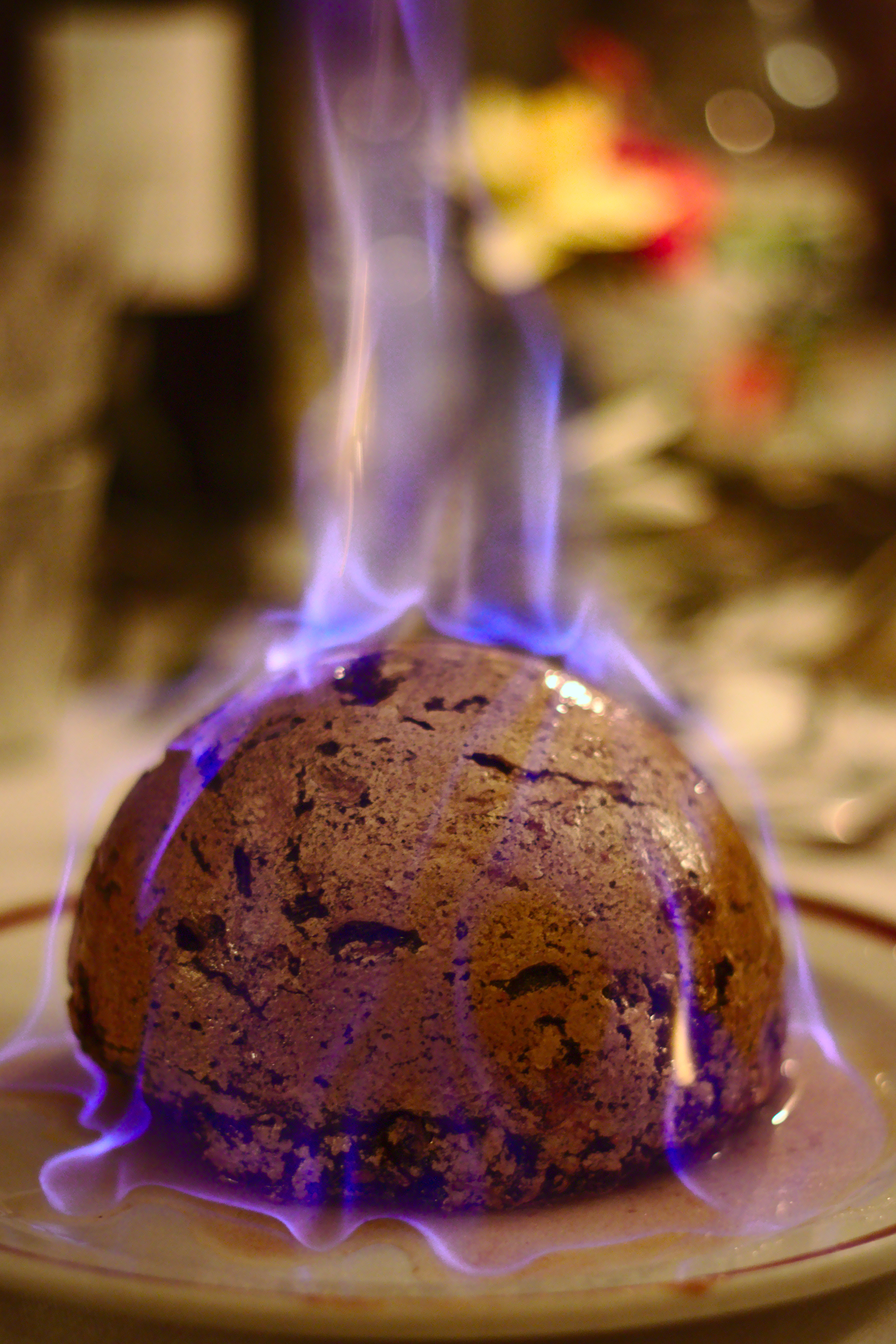
A Christmas pudding being flamed. Author Ed.g2s

Two years after the publication of A Christmas Carol, our dish appeared as an official “Christmas pudding” in Eliza Acton’s Modern Cookery for Private Families, a bestseller in 1845. This was Christmas pudding as we would recognise it – that is, a round sweet pudding, with no beef, but plenty of fruit and spices. The pudding mixture could be moulded to give it a more ornate shape. It was however, still served alongside the meat course.

Vintage Plum Pudding Image. Author : Graphics Fairy

Demise of the Christmas pudding?

During the twentieth century, this sweet dish became exactly that – the dessert we instantly recognise, served with cream, custard or brandy butter. Supermarkets began to stock a convenient packaged version, which only needs to be heated and served.

But times continue to change. Nowadays many older Brits, (but certainly not all), are still attached to Christmas pudding, maybe because it has been part of our lives for so long. However, the younger generation, it seems, are not particularly supportive of the Christmas pud, probably as it usually follows a very rich and heavy first and second course. The Royal Mint in a 2024 survey found that a whopping 59% of the British population said they did not consider the Christmas pudding to be essential to the festivities. What do you think?

Christmas pudding has been with us in various guises for hundred of years. It is still cherished by some. But do you think Christmas pudding will survive in the future? Do you love it or loathe it? Let me know!


Categories
Lanzarote Life in Lanzarote

Christmas in Lanzarote

Lanzarote, 2023

Have you got Christmas on your mind? Thinking about food, gifts, entertainment? A thousand other details? The UK goes into overdrive about Christmas from the beginning of November, and some people are pretty fed up with Christmasness (yes, I know it’s not really a word) by the time 25th December finally rolls around. I sometimes felt like this when I still lived in England.

Although I’ve lived in Spain for several years, I’ll be celebrating Christmas for the first time in Lanzarote this year. While Christmas in Spain has lots of similarities with Britain – it’s family time, we eat lots of special foodstuffs and give each other presents, the monarch makes a speech – there are some differences too. And some of them may surprise you.

The run-up to Christmas

Spain has Christmas ads and commercials, but not to the same extent as the U.K. where everyone is bombarded with a huge retail campaign from 1st November onwards, and it is also not uncommon to see Christmas items on sale well before the winter months.

Over the years I have lived in Spain, the yuletide preparations have slowly increased in volume and the Christmas promotions have started a little earlier each year – but still not to the extent reached in Britain.

Christmas shopping in Arrecife, Lanzarote’s capital, early December 2023 -no crowds!

Life is not perfect here in Lanzarote, or anywhere else. But the laid-back island vibe helps to keep everyone relatively sane. And the mild winter climate and sunshine help, of course….were it not for the festive decorations. it would be hard to believe that it really is Christmas.

Christmas Eve/ Nochebuena

British Christmas fare

So you may already know that we have our family Christmas dinner in the evening in Spain, on Christmas Eve. And we don’t have a set meal, like in England, where a traditional Christmas dinner consists of a roast turkey, with all the trimmings, although it’s also true that nowadays more and more people are choosing an alternative menu which caters more to their taste.

Spain is a diverse country, with a rich gastronomy that varies from province to province. This is why the Christmas Eve (Nochebuena) menu tends to differ everywhere in Spain.

Roast turkey might be on the menu, particularly in the Balearic Islands or in Galicia, in the northwest of the country. But the main dish could be any type of roast meat (lamb and pork are popular choices) or fish or even shellfish, taking advantage of the availability of local delicacies.

A delicious salmon dish

In the Canary Islands, fish is often the star of the show, as the Canaries have access to a wide variety of delicious fish from the Atlantic – for example, cherne (wreckfish) or bocanegra (scorpionfish). Many species of tasty locally sourced fish are available, which are not generally found in other parts of Spain.

Slicing the ham takes a certain skill

And there’s always a wide range of tapas provided as extra nibbles. In the colder parts of Spain in the north (not talking Canaries here, obviously) broths and soups are often on the menu to start off the feast.

Other extras might include jamón iberico (cured ham), cheeses, small pastries, prawns and other types of seafood. In the Canaries papas arrugadas (wrinkled and salted boiled potatoes) with delicious sauces (mojos) are also likely to make an appearance.

By deramaenrama – La Duquesita: Escaparate (turrones), CC BY 2.0, https://commons.wikimedia.org/w/index.php?curid=46344440

Sweet treats

In Spain we have many sweet treats during Christmas time, but one of the most traditional is turrón – a type of nougat made from honey and nuts which was popular from the Islamic conquest of Spain in 711. There were originally just two varieties

Turrón de Alicante – a rigid block of around 50% almonds plus honey and sugar.

Turrón de Jijona – this is nougat with a soft consistency, made from toasted crushed almonds and mixed with honey and egg whites.

In the photo above you can see turrón de Alicante third from the left on the second row. Turrón de Jijona is second from the left, first row.

Nowadays, apart from the original turrones, there are also many other varieties with a huge range of different flavours. The photo shows chocolate praline, glazed fruit, chocolate truffle and walnut, and rum and raisin, amongst others. Unfortunately these treats are probably not for anyone strictly watching their calorie intake.

The royal speech

And finally, a nod to the King’s speech, just like the UK. The only difference is that it’s always scheduled for 9pm on the evening of Nochebuena, at the same time as the family gathering… (oh, and it’s in Spanish, which you may have already guessed…)

Christmas Day/Día de Navidad

Christmas Day has a bit of a Boxing Day vibe, as everyone is recovering from the festivities the night before. But it’s still a bank holiday and an important day in the calendar.

A lot of Spanish people will go out for a special lunch to celebrate, and there are always eateries in holiday destinations which offer English Christmas dinners – although I would advise you to also sample some of the incredible gastronomy Spain has to offer.

The old Spanish tradition of receiving presents from the Three Kings on Epiphany, January 6th, is still going strong. However, with globalisation, and the practicality of children being able to enjoy their presents for the remainder of the Christmas holidays, gifts are given more and more on 25th December, although a lot of lucky Spanish kids will also receive another gift on January 6th from the Three Kings. We know these regal giftbearers as the Three Wise Men.

This post may have arrived just after Christmas Day, but wishing all our readers the very best for the rest of Christmas season.

Do you know of any more Christmas traditions in other countries which are totally different to Britain?