
Victorian society
The Victorian era had very strict social norms that are alien to the world we live in today. Displays of emotion were frowned upon in public. Women were expected to stay chaste and innocent before marriage and had chaperones to ensure they did not breach social etiquette. Couples in romantic relationships were not given much privacy – they would communicate via handwritten letters or go on walks to be able to spend time alone. However, despite social codes of behaviour and respectability, people were still, well, people, and felt the same range of emotions that we can express freely today.
Floriography
Bearing in mind the restrictions of Victorian etiquette, it might not have been easy to approach your love interest, let alone hold a conversation. So messages in code were sent using flowers. Floriography – the language of flowers – was not limited to romance, flowers were also sent as a gift of gratitude or friendship, but it was commonly used to convey romantic concepts. Floriography peaked in popularity in Britain as well as France and the U.S. during the Victorian era.
Flowers and their special meanings allowed individuals to express their feelings discreetly in a world of propriety where direct expression of emotion was frowned upon in public.
Floral dictionaries
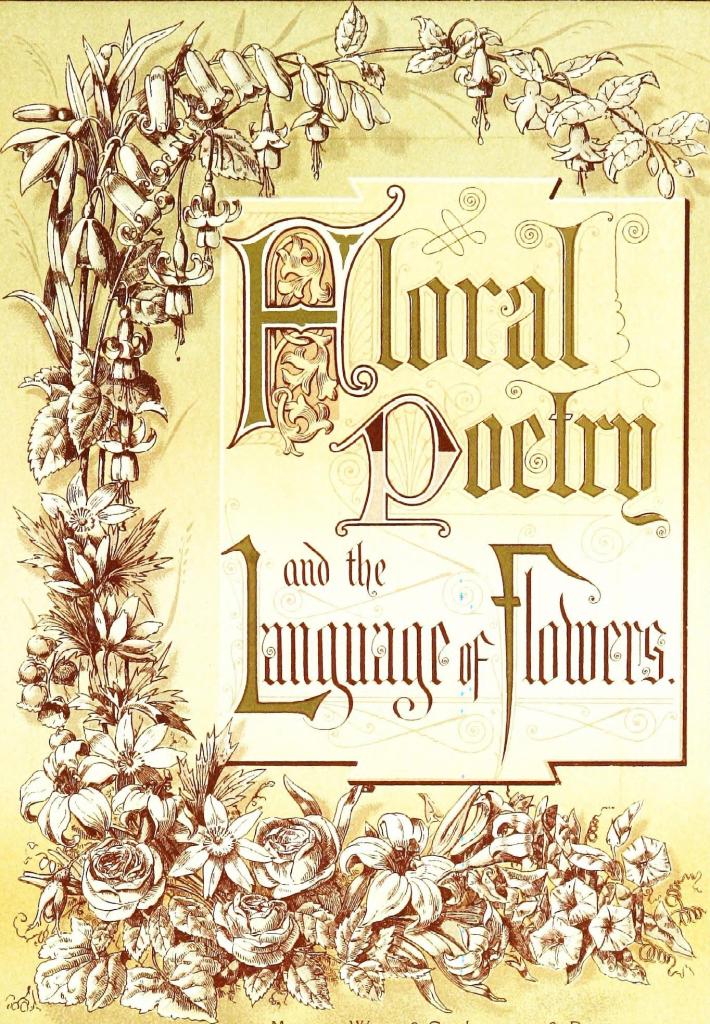
Internet Archive Book Images, No restrictions, via Wikimedia Commons
Coincidentally, this was also an era when there was a burgeoning interest in botany, and new publications described the different characteristics of flowers and plants in detail. Floriography was around long before the Victorian age and attributing specific meanings to flowers had been seen before in other periods and cultures – in Japan, Ottoman Turkey and the Hebrew Bible, for example.
But back to the Victorian era. In this period, florists saw their businesses boom, alongside the creation of floral dictionaries, like the one shown above. One of the most famous was The Language of Flowers by Kate Greenaway, published in 1884, and shown below. This book is actually still on sale on the Amazon website today.
There were several dictionaries of this type by the beginning of the 1900s, so often the flowers were a symbol for more than one concept. An anemone, for example, could mean hopeless love, or anticipation. A combination of flowers could convey a more complex message, and the arrangement of the flowers was also significant. The intended message could be changed by just a small variation in the bouquet. It all seems intriguing and kind of fun. No wonder the floral dictionaries were flying off the shelves.

Floral Meanings
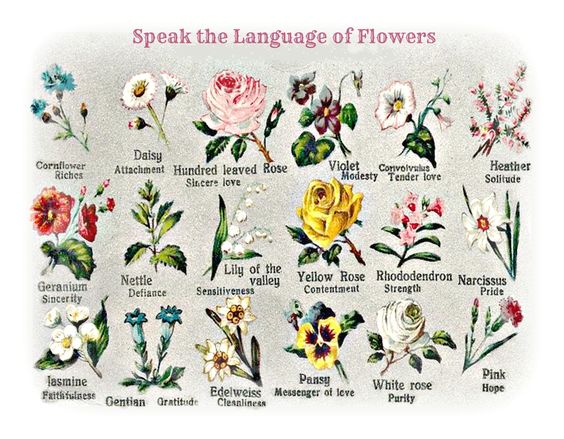
The flowers were grown in English gardens so were generally seasonal – roses, daffodils, chrysanthemums and delphiniums were popular. Roses expressed the idea of love but its colour added nuance to its significance. Daffodils could mean prosperity, loyalty or new beginnings. Chrysanthemums expressed friendship, and delphiniums dignity and rebirth. Sweet pea flowers were often chosen to show gratitude for hospitality. Confused? It’s not hard to see why flower dictionaries were popular – the interpretation of a Victorian bouquet was possibly not a simple task. The images below convey more ideas the flower sender might wish to express.

It was also meaningful where the recipient placed or wore the flowers after their delivery. To quote J.B. Meadow:
A woman also had to be pretty precise about where she wore flowers. Say, for instance, a suitor had sent her a tussie-mussie (a.k.a. nosegay). If she pinned it to the ‘cleavage of bosom’, that would be bad news for him, since that signified friendship. Ah, but if she pinned it over her heart, ‘That was an unambiguous declaration of love’.
The colours of the chosen flowers were also imbued with meaning.
Red – passion, devotion
Yellow – affection, fondness
Blue – loyalty, truth, dignity
White – purity, innocence
Pink – appreciation, elegance
Orange- enthusiasm, good wishes
Decline of Floriography
In the 1900s, as society gradually began to relax its strict rules of social etiquette and with advances in technology which improved communication, the need for flower messages began to disappear. With the start of World War One, the laborious process of cultivating the flowers was abandoned as other priorities came to the fore.
Some of the strongest associations with flowers have stayed with us until today – red roses still signify passion, poppies are a symbol of those lost at war, and lilies represent purity.
And a gift of flowers is still a beautiful present which generally conveys some type of sentiment from the sender – love, sympathy, congratulations, friendship. Maybe next time you send or receive flowers, spare a thought for the Victorians and their floral dictionaries.


11 replies on “The language of flowers”
I completely agree that we should try to uphold the free expression of feelings and opinions as much as we can but I do see that in certain situations there is a going to be a clash between our desire to allow people to say what they think or how they feel and our responsibility to protect people who might find certain views very hurtful or offensive. I feel that the way people express themselves is more important than what they actually say. I would say that people should be able to express their feelings and opinions without fear of censure but they do have a responsibility to do so respectfully. So we shouldn’t shout or talk over people or mock or make fun of them. I find it really hard to watch discussions on television where people become aggressive and refuse to listen to each other. Perhaps in Victorian times people were more respectful and made more of an effort to engage with the issues rather than simply abusing and insulting people like on Twitter? It seems that a lot of the time there isn’t really much point to “debates” because people don’t approach them with an open mind and they aren’t prepared to reconsider their views or positions and we just end up with a slanging match!
LikeLike
I totally agree Charlotte, that sadly, we see very little respectful and intelligent debate these days. In Victorian society, people were much more polite to each in public, although this could have been down to a desire to uphold the conventions more than anything else. And undoubtedly it would have made for less aggressive exchanges than those we are subjected to today!
LikeLiked by 1 person
I’m really sorry if this is going off on too much of a tangent but I was just wondering if you think that in other countries there have been similar changes to those that have taken place in Britain, with people becoming more outspoken and more comfortable with expressing their feelings? It seems that the stereotype of the British stiff upper lip is based on how people were in Victorian times and is probably outdated now. There seems to be a stereotype that people from countries in the south of Europe like Italy and Spain are more expressive and tactile and my impression is that maybe our society is becoming more like this – we are moving away from the traditional British stereotype of being very reserved and not expressing how we feel and becoming more at ease with displaying emotion. I would be interested to know if in the olden days people in other European countries were more reserved and less comfortable with expressing their feelings, or if people abroad have always been more open about how they feel and Britain was the exception. Do you think other countries have changed in the same way as Britain, or were their norms and conventions 200 years ago closer to what they are today? I’m very sorry I haven’t managed to explain this very well!
LikeLike
You’ve explained yourself very well, Charlotte, and there’s absolutely no problem with going off on a tangent, that’s what makes the comments interesting!
I would say that in European countries there were generally more social conventions at the beginning of the 1900s and for various reasons (the world wars, women’s rights, the rise of a more individualistic society) many of these social norms began to be dropped.
I agree that in Britain we have become much more Mediterranean in our attitudes and having a stiff upper lip these days is not much of a priority for the majority of people. As a nation, Britain has changed a lot in this respect.
And I would add that the rise in social media over the last 20 years has given anyone with a computer or a mobile phone the means to express themselves to an audience – I guess that has produced a lot more discussion and debate than was ever possible in the past, and we are used to seeing people’s ideas and opinions everywhere. However, it’s sad that some of it is not very palatable, or downright offensive. It is very complicated to control and it’s probably an issue anywhere in the world with an Internet connection.
LikeLiked by 1 person
I really enjoyed this post! I’m so sorry I didn’t manage to keep following your blog as I used to love reading your posts. I always used to learn so much from you! I just thought I should say that there is a song I really like called “Language of Flowers”. It’s by a band called Pale Saints and until I read your post I had no idea what it was about! I really like the tune but I had never really thought about the words. Now I’ve read your post I’ll have a look at the lyrics and see if I can understand what they mean!
I find it really interesting how attitudes and ways of behaving have changed over the years. I remember watching a programme in which one of the contributors suggested that maybe the pendulum has swung too far in the other direction. I think she was suggesting that maybe today people overshare and are too explicit and not as dignified as they used to be. Today it seems really natural for people to tell others how they feel but I guess that someone who lived in Victorian times would find our attitude to expressing emotion really strange and they probably wouldn’t be nearly as comfortable opening up to people or telling people how they feel.
LikeLiked by 1 person
Thank you so much for your interest and your comments, Charlotte! We tend to think of the Victorians as being terribly repressed but you make a good point that their behaviour was certainly more dignified and polite than a lot of what we see today. And they still enjoyed life despite their societal norms.
LikeLiked by 1 person
I’m so sorry it’s taken me all week to write back! Do you think that society will ever move back to being more like it was in Victorian times or do you think that now people have become more comfortable with expressing emotion things will stay like this forever? I remember watching a programme in which someone suggested that history tends to repeat itself in cycles and we end up going back to the norms and attitudes that characterised previous generations. I think some people say that in some respects we have become quite puritanical and intolerant, just like people were hundreds of years ago. It seems that today there are certain things you aren’t allowed to say and certain attitudes and beliefs you aren’t allowed to have, just as in the olden days there were certain religious views you weren’t allowed to espouse. (Please forgive me if “espouse” isn’t really the right word!) It seems that today people try to cancel you or demonise you if they don’t like one of your attitudes or beliefs, as if you are a terrible person just for feeling a certain way about something. Maybe life would be easier and people would be less anxious if we were more like the Victorians and kept our feelings private – we wouldn’t have to worry so much about upsetting or offending people!
LikeLike
These are very interesting points, Charlotte. What I think is that cultural norms in society shift and change with the times, but people have always had the same feelings and emotions.
Despite my fascination with the Victorians, I would not have liked to have been a woman in that era – it was very difficult for a woman to be independent and we are lucky enough to live in an era where women have a lot more rights and freedom (although there is always more room for improvement, right?)
But I also agree with you that today, especially with the advent of social media, people can express their opinions freely, and some opinions can be harsh, judgmental and sometimes very offensive. Not to mention the amount of disinformation out there, which causes so many issues.
I certainly don’t have all the answers but I think people should be allowed to express feelings and opinions. But we should try to ensure our opinions are based on real facts, whilst respecting that other people may not feel the same way and protecting the vulnerable from hate speech. Do you agree?
LikeLiked by 1 person
Interesting stuff, indeed. Also interesting in that it was really just the upper and middle classes who this affected. The lower classes had no need for, time for, or, indeed, the money for any of it. I expect there would have been one or two exceptions, though.
LikeLike
Yes, totally agree Mick! In my previous blog posts on the Victorian era I’ve often highlighted the sharp contrast between the haves and have-nots of Victorian England and I probably should have mentioned this again here. In some ways I feel that although the poor and the less well-off did not enjoy the benefits of wealth, they were also free from many of the restrictive social norms that the middle and upper classes were obliged to follow. I also agree with you that people don’t always fit neatly into any one of these categories or classes.
LikeLiked by 1 person
I suspect in some ways it would have been quite good to be lower middle class in those days. Always assuming you weren’t laid low by disease, robbery, etc etc…
LikeLiked by 1 person