
Victorian society
The Victorian era had very strict social norms that are alien to the world we live in today. Displays of emotion were frowned upon in public. Women were expected to stay chaste and innocent before marriage and had chaperones to ensure they did not breach social etiquette. Couples in romantic relationships were not given much privacy – they would communicate via handwritten letters or go on walks to be able to spend time alone. However, despite social codes of behaviour and respectability, people were still, well, people, and felt the same range of emotions that we can express freely today.
Floriography
Bearing in mind the restrictions of Victorian etiquette, it might not have been easy to approach your love interest, let alone hold a conversation. So messages in code were sent using flowers. Floriography – the language of flowers – was not limited to romance, flowers were also sent as a gift of gratitude or friendship, but it was commonly used to convey romantic concepts. Floriography peaked in popularity in Britain as well as France and the U.S. during the Victorian era.
Flowers and their special meanings allowed individuals to express their feelings discreetly in a world of propriety where direct expression of emotion was frowned upon in public.
Floral dictionaries
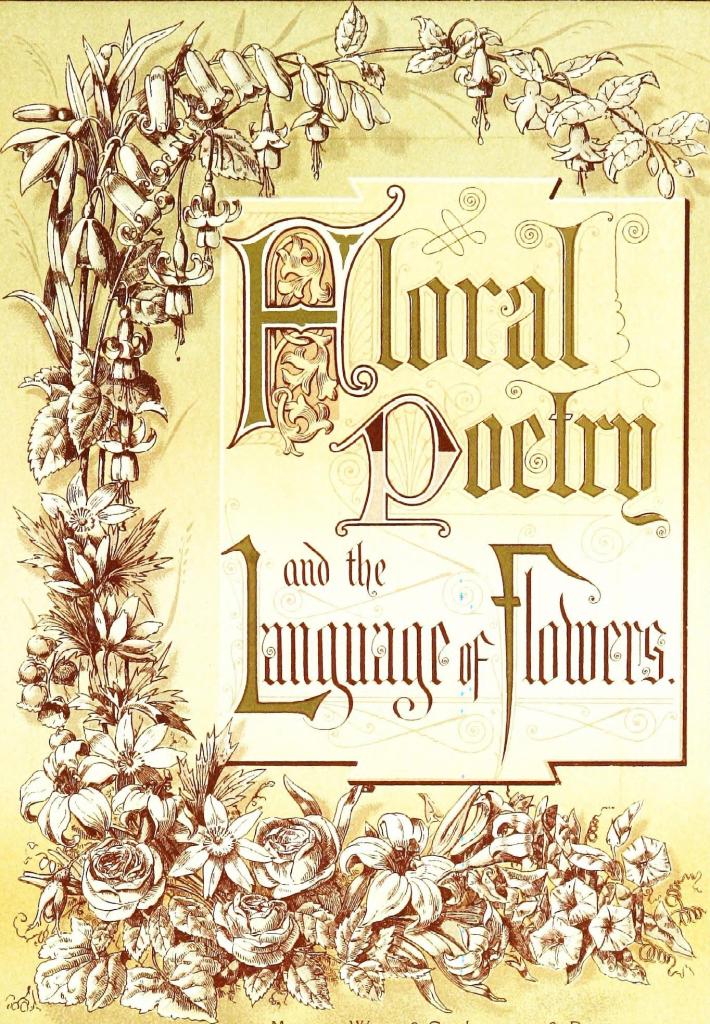
Internet Archive Book Images, No restrictions, via Wikimedia Commons
Coincidentally, this was also an era when there was a burgeoning interest in botany, and new publications described the different characteristics of flowers and plants in detail. Floriography was around long before the Victorian age and attributing specific meanings to flowers had been seen before in other periods and cultures – in Japan, Ottoman Turkey and the Hebrew Bible, for example.
But back to the Victorian era. In this period, florists saw their businesses boom, alongside the creation of floral dictionaries, like the one shown above. One of the most famous was The Language of Flowers by Kate Greenaway, published in 1884, and shown below. This book is actually still on sale on the Amazon website today.
There were several dictionaries of this type by the beginning of the 1900s, so often the flowers were a symbol for more than one concept. An anemone, for example, could mean hopeless love, or anticipation. A combination of flowers could convey a more complex message, and the arrangement of the flowers was also significant. The intended message could be changed by just a small variation in the bouquet. It all seems intriguing and kind of fun. No wonder the floral dictionaries were flying off the shelves.

Floral Meanings
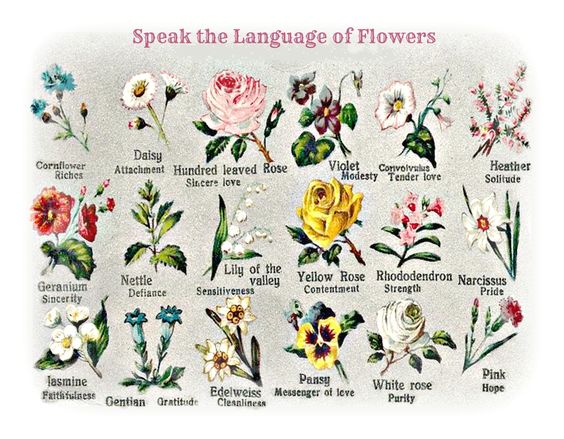
The flowers were grown in English gardens so were generally seasonal – roses, daffodils, chrysanthemums and delphiniums were popular. Roses expressed the idea of love but its colour added nuance to its significance. Daffodils could mean prosperity, loyalty or new beginnings. Chrysanthemums expressed friendship, and delphiniums dignity and rebirth. Sweet pea flowers were often chosen to show gratitude for hospitality. Confused? It’s not hard to see why flower dictionaries were popular – the interpretation of a Victorian bouquet was possibly not a simple task. The images below convey more ideas the flower sender might wish to express.

It was also meaningful where the recipient placed or wore the flowers after their delivery. To quote J.B. Meadow:
A woman also had to be pretty precise about where she wore flowers. Say, for instance, a suitor had sent her a tussie-mussie (a.k.a. nosegay). If she pinned it to the ‘cleavage of bosom’, that would be bad news for him, since that signified friendship. Ah, but if she pinned it over her heart, ‘That was an unambiguous declaration of love’.
The colours of the chosen flowers were also imbued with meaning.
Red – passion, devotion
Yellow – affection, fondness
Blue – loyalty, truth, dignity
White – purity, innocence
Pink – appreciation, elegance
Orange- enthusiasm, good wishes
Decline of Floriography
In the 1900s, as society gradually began to relax its strict rules of social etiquette and with advances in technology which improved communication, the need for flower messages began to disappear. With the start of World War One, the laborious process of cultivating the flowers was abandoned as other priorities came to the fore.
Some of the strongest associations with flowers have stayed with us until today – red roses still signify passion, poppies are a symbol of those lost at war, and lilies represent purity.
And a gift of flowers is still a beautiful present which generally conveys some type of sentiment from the sender – love, sympathy, congratulations, friendship. Maybe next time you send or receive flowers, spare a thought for the Victorians and their floral dictionaries.
 english-stuff.com

You must be logged in to post a comment.