You may think that this post is somewhat late – surely carnivals take place in February around the time of Pancake Tuesday and Mardi Gras, don’t they ? Well, yes and no.
Carnival celebrations are huge in the Canary Islands, and Lanzarote very much adheres to this rule. Carnival is not programmed on fixed dates, but this year carnaval season began on 1st February, with festivities, concerts and events in the capital city of Arrecife….and will conclude a whole 6 weeks later (yes, 6 weeks.!!) on 10th March, ending with a week of parades and activities in the neighbouring island of La Graciosa, just north of Lanzarote.
Carnaval arrives in the small island of La Graciosa, north of Lanzarote, 2023
Parades, concerts,music and pageants
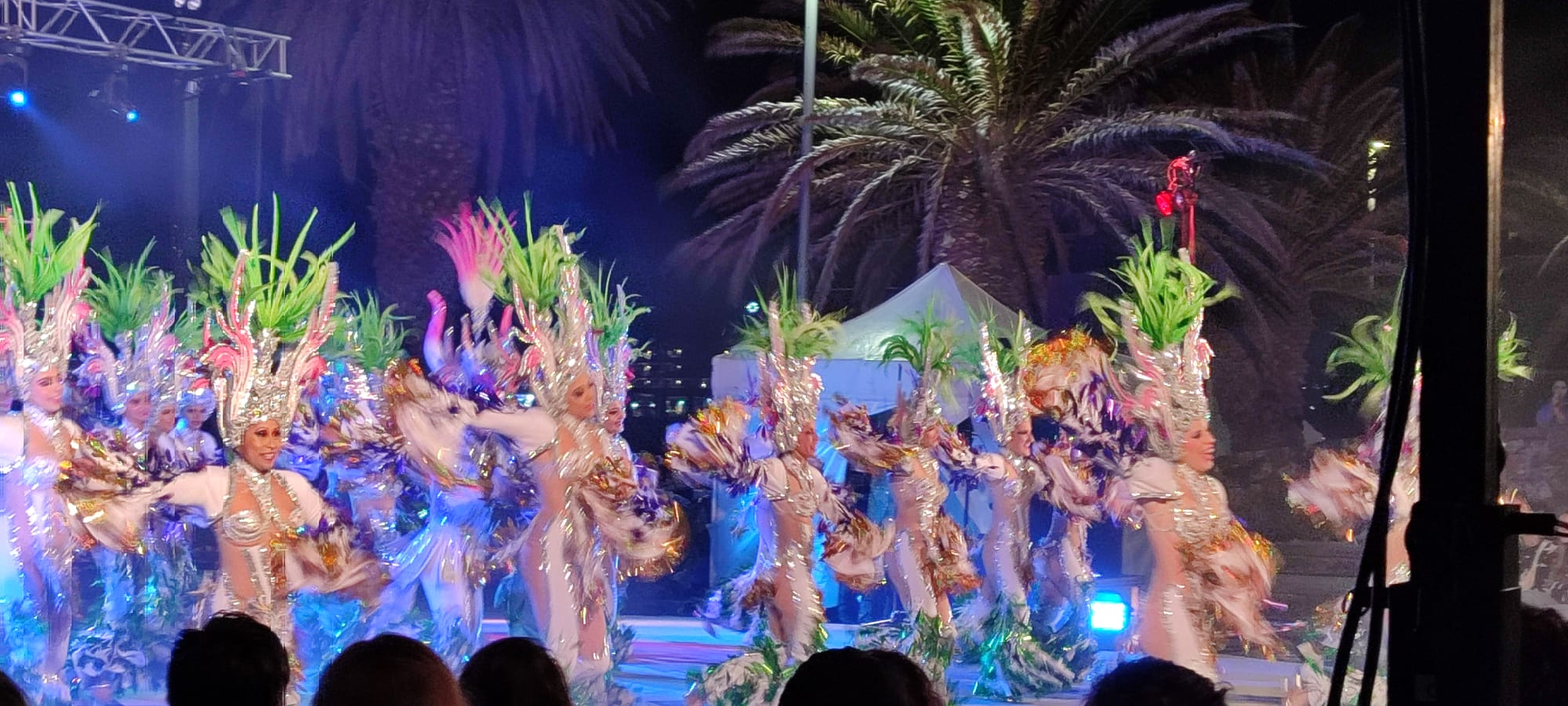
The local streets are buzzing with activity at this time of year, and residents and tourists alike join in the noisy celebrations. There are elaborate costumes, floats and live music, ranging from the more traditional Canarian music to the latest hits. For many of the locals carnaval is a bigger event than Christmas and many bystanders will be dressed in costumes simply to watch the culmination of events as the carnival procession passes by.
But there is more to all this than just music and dancing. Some carnival traditions are intertwined with social history in Lanzarote.
A bit of history from local towns
Arrecife
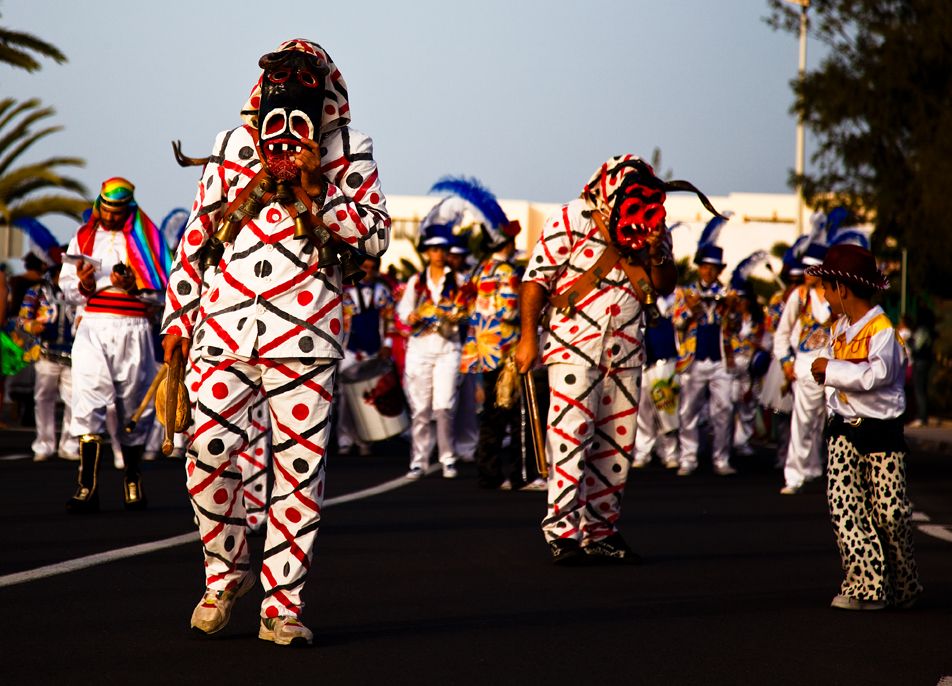
Los Buches de Arrecife, a long standing tradition. Photo – Ramón Pérez Niz.
In Arrecife, from the beginning of the 19th century, the bucheros, masked and dressed in old-fashioned peasant clothing, and masked, would playfully threaten the passersby with their “weapons”, (buches) which were fashioned from the inflated bladders of large fish……hmm, maybe not the most attractive thought. In the past, the bucheros would refuse to work on the ships in Arrecife during carnival season and were fed by the locals who would welcome them into their houses.
Despite opposition from the Church and the prohibitionof the bucheros dating from the Spanish Civil War in the 1930s until the 1960s, the bucheros are still “attacking” the carnival goers today…. albeit in a revamped costume seen above in the photo (and no longer using authentic fish bladders, you may be relieved to learn.)
Teguise
Los diabletes de Teguise – the little devils from the town of Teguise, the old capital of Lanzarote.
The use of devil images is widespread througout carnivals globally, and is often a mischevious figure attempting to cause mayhem. The diabletes (little devils) of Teguise are no exception, chasing and frightening the younger inhabitants.
Their distinctive costumes with their red and green diamonds, and their colourful masks, denote both their impish nature and also symbolise fertility/virility.
Carnaval in Lanzarote offers not only a great opportunity to enjoy the vibrant celebrations, but also a unique insight into the rich cultural heritage of this spectacular island.
Have you got Christmas on your mind? Thinking about food, gifts, entertainment? A thousand other details? The UK goes into overdrive about Christmas from the beginning of November, and some people are pretty fed up with Christmasness (yes, I know it’s not really a word) by the time 25th December finally rolls around. I sometimes felt like this when I still lived in England.
Although I’ve lived in Spain for several years, I’ll be celebrating Christmas for the first time in Lanzarote this year. While Christmas in Spain has lots of similarities with Britain – it’s family time, we eat lots of special foodstuffs and give each other presents, the monarch makes a speech – there are some differences too. And some of them may surprise you.
The run-up to Christmas
Spain has Christmas ads and commercials, but not to the same extent as the U.K. where everyone is bombarded with a huge retail campaign from 1st November onwards, and it is also not uncommon to see Christmas items on sale well before the winter months.
Over the years I have lived in Spain, the yuletide preparations have slowly increased in volume and the Christmas promotions have started a little earlier each year – but still not to the extent reached in Britain.
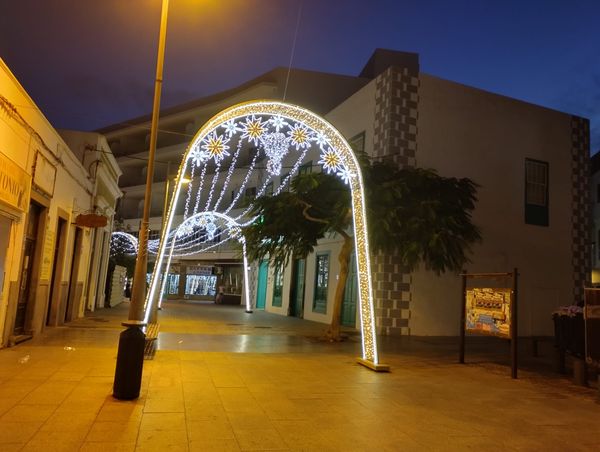
Christmas shopping in Arrecife, Lanzarote’s capital, early December 2023 -no crowds!
Life is not perfect here in Lanzarote, or anywhere else. But the laid-back island vibe helps to keep everyone relatively sane. And the mild winter climate and sunshine help, of course….were it not for the festive decorations. it would be hard to believe that it really is Christmas.
Christmas Eve/ Nochebuena
British Christmas fare
So you may already know that we have our family Christmas dinner in the evening in Spain, on Christmas Eve. And we don’t have a set meal, like in England, where a traditional Christmas dinner consists of a roast turkey, with all the trimmings, although it’s also true that nowadays more and more people are choosing an alternative menu which caters more to their taste.
Spain is a diverse country, with a rich gastronomy that varies from province to province. This is why the Christmas Eve (Nochebuena) menu tends to differ everywhere in Spain.
Roast turkey might be on the menu, particularly in the Balearic Islands or in Galicia, in the northwest of the country. But the main dish could be any type of roast meat (lamb and pork are popular choices) or fish or even shellfish, taking advantage of the availability of local delicacies.
A delicious salmon dish
In the Canary Islands, fish is often the star of the show, as the Canaries have access to a wide variety of delicious fish from the Atlantic – for example, cherne (wreckfish) or bocanegra (scorpionfish). Many species of tasty locally sourced fish are available, which are not generally found in other parts of Spain.
Slicing the ham takes a certain skill
And there’s always a wide range of tapas provided as extra nibbles. In the colder parts of Spain in the north (not talking Canaries here, obviously) broths and soups are often on the menu to start off the feast.
Other extras might include jamón iberico (cured ham), cheeses, small pastries, prawns and other types of seafood. In the Canaries papas arrugadas (wrinkled and salted boiled potatoes) with delicious sauces (mojos) are also likely to make an appearance.
In Spain we have many sweet treats during Christmas time, but one of the most traditional is turrón – a type of nougat made from honey and nuts which was popular from the Islamic conquest of Spain in 711. There were originally just two varieties
Turrón de Alicante – a rigid block of around 50% almonds plus honey and sugar.
Turrón de Jijona – this is nougat with a soft consistency, made from toasted crushed almonds and mixed with honey and egg whites.
In the photo above you can see turrón de Alicante third from the left on the second row. Turrón de Jijona is second from the left, first row.
Nowadays, apart from the original turrones, there are also many other varieties with a huge range of different flavours. The photo shows chocolate praline, glazed fruit, chocolate truffle and walnut, and rum and raisin, amongst others. Unfortunately these treats are probably not for anyone strictly watching their calorie intake.
The royal speech
And finally, a nod to the King’s speech, just like the UK. The only difference is that it’s always scheduled for 9pm on the evening of Nochebuena, at the same time as the family gathering… (oh, and it’s in Spanish, which you may have already guessed…)
Christmas Day/Día de Navidad
Christmas Day has a bit of a Boxing Day vibe, as everyone is recovering from the festivities the night before. But it’s still a bank holiday and an important day in the calendar.
A lot of Spanish people will go out for a special lunch to celebrate, and there are always eateries in holiday destinations which offer English Christmas dinners – although I would advise you to also sample some of the incredible gastronomy Spain has to offer.
The old Spanish tradition of receiving presents from the Three Kings on Epiphany, January 6th, is still going strong. However, with globalisation, and the practicality of children being able to enjoy their presents for the remainder of the Christmas holidays, gifts are given more and more on 25th December, although a lot of lucky Spanish kids will also receive another gift on January 6th from the Three Kings. We know these regal giftbearers as the Three Wise Men.
This post may have arrived just after Christmas Day, but wishing all our readers the very best for the rest of Christmas season.
Do you know of any more Christmas traditions in other countries which are totally different to Britain?
Most people know Lanzarote these days as a popular British holiday destination in the Canary Islands, but the island has survived its share of tragedy and suffering. In the 1700s volcanic eruptions shook Lanzarote and destroyed much of the agricultural land, the island’s principal activity.
The situation was disastrous for many local inhabitants, who were forced to emigrate, mainly to Cuba and the Americas. In the following years to come, there would be periods of drought, food shortages, epidemics and more volcanic activity. This produced a wave of emigration that lasted until the 1950s.
It is possible that Carlos Gutierrez was one of these emigrants. Not much is known about Carlos – his birthplace is debated, but no matter if he was born in Lanzarote or Cuba, Carlos would have grown up around the sea, and been familiar with both Atlantic waters and the Gulf Stream winds. As an older adult, in the 1930s, he became a fishing mate of Ernest Hemingway the writer, who was also living in Cuba at the time.
Hemingway and Pilar
Hemingway, a keen angler, had acquired a 12-metre boat in 1934 and named it Pilar, a name he used for his second wife, Pauline. The boat was used for sailing and fishing trips around the Caribbean. Carlos Gutierrez became the first captain onboard Pilarfor Hemingway, whose passion for the sea would have a strong influence on his writing.
Ernest Hemingway (left) and Carlos Gutierrez (right) onboard Pilar. Photograph in the Ernest Hemingway Photograph Collection, John F. Kennedy Presidential Library and Museum, Boston. Author unattributed.
During fishing expeditions prior to the purchase of Pilar, Carlos had taught him techniques for catching marlin, a species related to swordfish, but with a crest and a long spear-like jaw. Marlin fish, large bony fish, weighing up to 450 kg, were fished by Hemingway in Florida, the Bahamas and Cuba, but they were also well-known in the Atlantic waters surrounding Lanzarote. The photo below shows Ernest, Pauline and sons, along with some unfortunate marlin, in Birmini, on the west of Bermuda, where the family lived from 1935 to 1937.
Pauline, Patrick, Ernest, John, and Gregory Hemingway with four marlins on the dock in Bimini, 20 July 1935. Ernest Hemingway Collection/John F. Kennedy Presidential Library, Boston.
There is no doubt that Hemingway was an excellent angler and that much of his time was dedicated to fishing. But according to Jeffrey Meyers who wrote a biography of Hemingway in 1985, his boat was also a
”kind of a floating whorehouse and rum factory as well as a fishing boat.”
So it would seem Hemingway got his kicks in other ways on Pilar and this would eventually lead to Carlos’s downfall. Sources say Carlos Gutierrez was sacked by Jane Mason, Hemingway’s mistress at the time, when she discovered that Ernest was spending time onboard with Martha Gelhorn, who would eventually become his third wife. He was still married to Pauline at the time.
So Martha replaced Pauline and Jane, and likewise, Carlos Gutierrez’s role was filled by Gregorio Fuentes.
Gregorio Fuentes
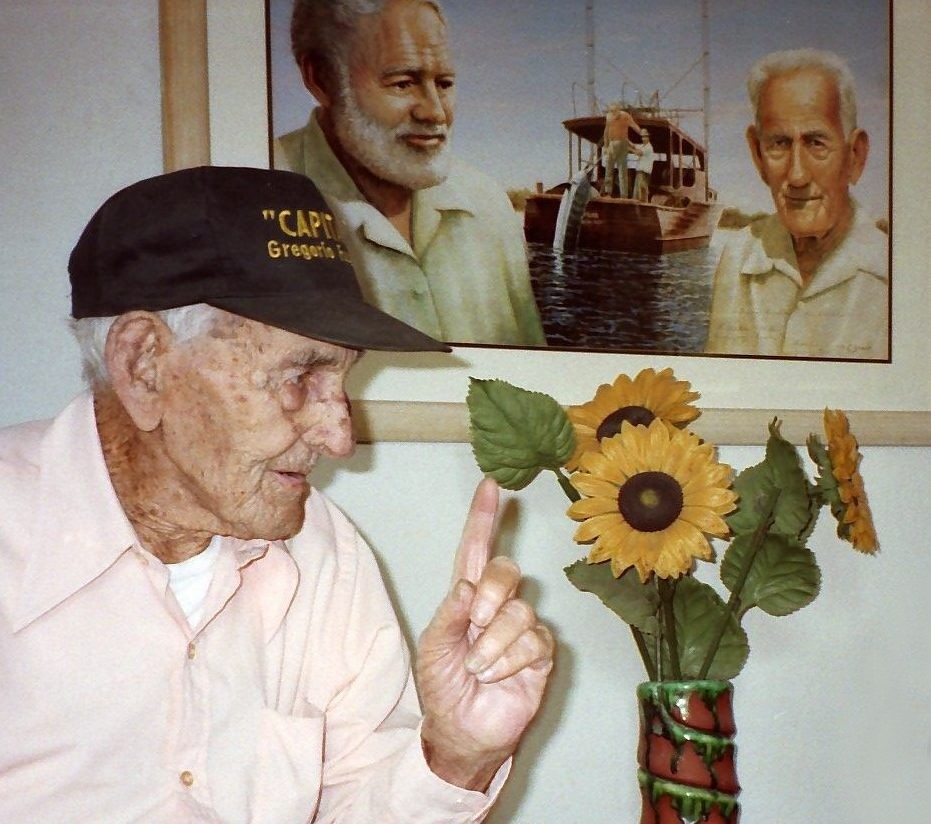
We know for sure that Gregorio Fuentes was born in El Charco de Ginés, in Arrecife, the capital city of Lanzarote, in the 1890s. He is said to have emigrated to Cuba at the age of 6 with his father, who sadly did not survive the voyage. It was all too familiar for passengers to die during the journey due to either lack of sanitary conditions, tropical diseases or a combination of both. On arrival, young Gregorio was taken care of by other passengers from the Canary Islands who were also emigrating to Cuba. Another source says he migrated to Cuba permanently at the age of 22, after working in the Canaries, Valencia and Seville on the docks.
There are also conflicting stories on how Gregorio met Hemingway, but one thing is clear – they were bonded by their love of the sea. Legend says that Gregorio, who at the time captained another boat, saved Hemingway and his crew from a tropical storm in 1928. It is indisputable that Gregorio and Ernest established a lasting friendship after Ernest established himself in Cuba in 1939, and Gregorio worked on the deck of Pilar, eventually replacing Carlos as captain. They would go out on fishing expeditions that lasted 3 or 4 days and any further details of what happened onboard were never divulged by Gregorio.
Andy García, the Cuban American actor, in collaboration with HilaryHemingway, Ernest’s niece, has written a screenplay of this friendship although the film appears to have remained in a developmental stage for several years.
Poster for the Hemingway and Fuentes film, still in production. The photographic image is authentic.
The Old Man and the Sea
By 1961, Hemingway had married his fourth wife Mary, won the Pulitzer Prize for The Old Man and the Sea, was awarded the Nobel Prize for Literature and moved back to the States, where he committed suicide after bouts of physical illness and depression. He left his boat Pilar, home of so many fishing expeditions, to his staunch ally Gregorio, who in turn left it to the Cuban people. The boat is still on display in Havana.
The Old Man and the Sea was Hemingway’s last major work of fiction, written in Cuba in 1951. It recounts the story of Santiago, an ageing Cuban fisherman who has an epic battle on his fishing boat to catch a giant marlin, with themes of perseverance and suffering.
Gregorio is often cited as being the model for Hemingway’s protagonist, Santiago, although it also seems highly probable that Carlos Gutierrez, Pilar’s first captain and master fisherman, would have provided Hemingway with both inspiration and expert knowledge of how to catch marlin. Hemingway himself claimed that Santiago was not based on anybody. Gregorio, in later life, was known to charge tourists in Cuba for tales of his friendship with Hemingway, and these memories often emphasised his links to the hero of The Old Man and The Sea.
What cannot be denied is that the world-renowned Ernest Hemingway and this humble fisherman born in Lanzarote forged a deep friendship of over 20 years, bound by their passion for fishing and the sea.
Gregorio Fuentes lived in his adopted hometown of Cojimar in Cuba until the grand old age of 104. He died in 2002, having never read The Old Man and the Sea for himself, as he was never taught how to read.
Like all new adventures, these past few weeks have brought me stress and pleasant surprises. I have island-hopped. From 30 years of living in the bustling capital city of Mallorca to the volcanic landscapes and cacti of Lanzarote in the Canary Islands.
Palma will always have a piece of my heart, but it has changed immensely over the period I lived there. Mallorca is indeed a stunning island – please don’t write it off if you have seen the rowdy streets of Magalluf in the media, there is so much more to the island; a wide variety of picturesque coves and magnificent beaches, quaint fishing ports, beautiful scenery throughout the rural interior which is incredibly green and fertile, not to mention the bustling capital city of Palma with its famous cathedral facing out to the sea. The iconic cathedral, a magnificent piece of architecture, was one of my first glimpses of Palma when I first fell in love with this place.
But Palma has moved on with the times. It is still, of course, an attractive city for visitors and I hope, always will be. But for residents, there is constant traffic congestion and cruise ship arrivals on various days of the week in the summer, with their humongous outpourings of tourists adding to the crowds. The climate is becoming progressively hotter and more humid. So my other half and I have taken the plunge and moved to a cooler (and definitely windier) climate where the population is smaller.
Will we stay here forever? I don’t know. But I hope that we will be happy here. More updates soon…










 english-stuff.com
You must be logged in to post a comment.